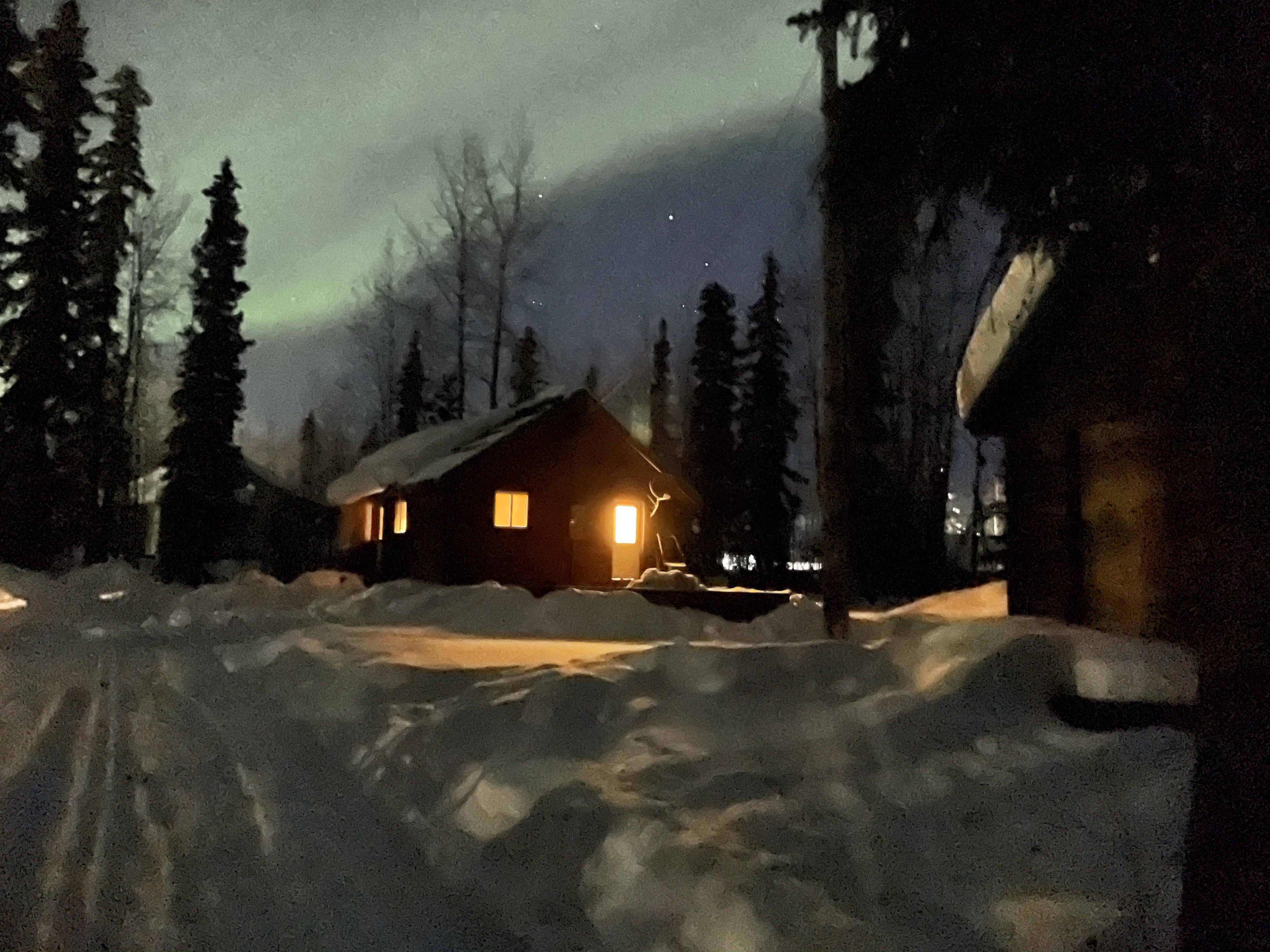
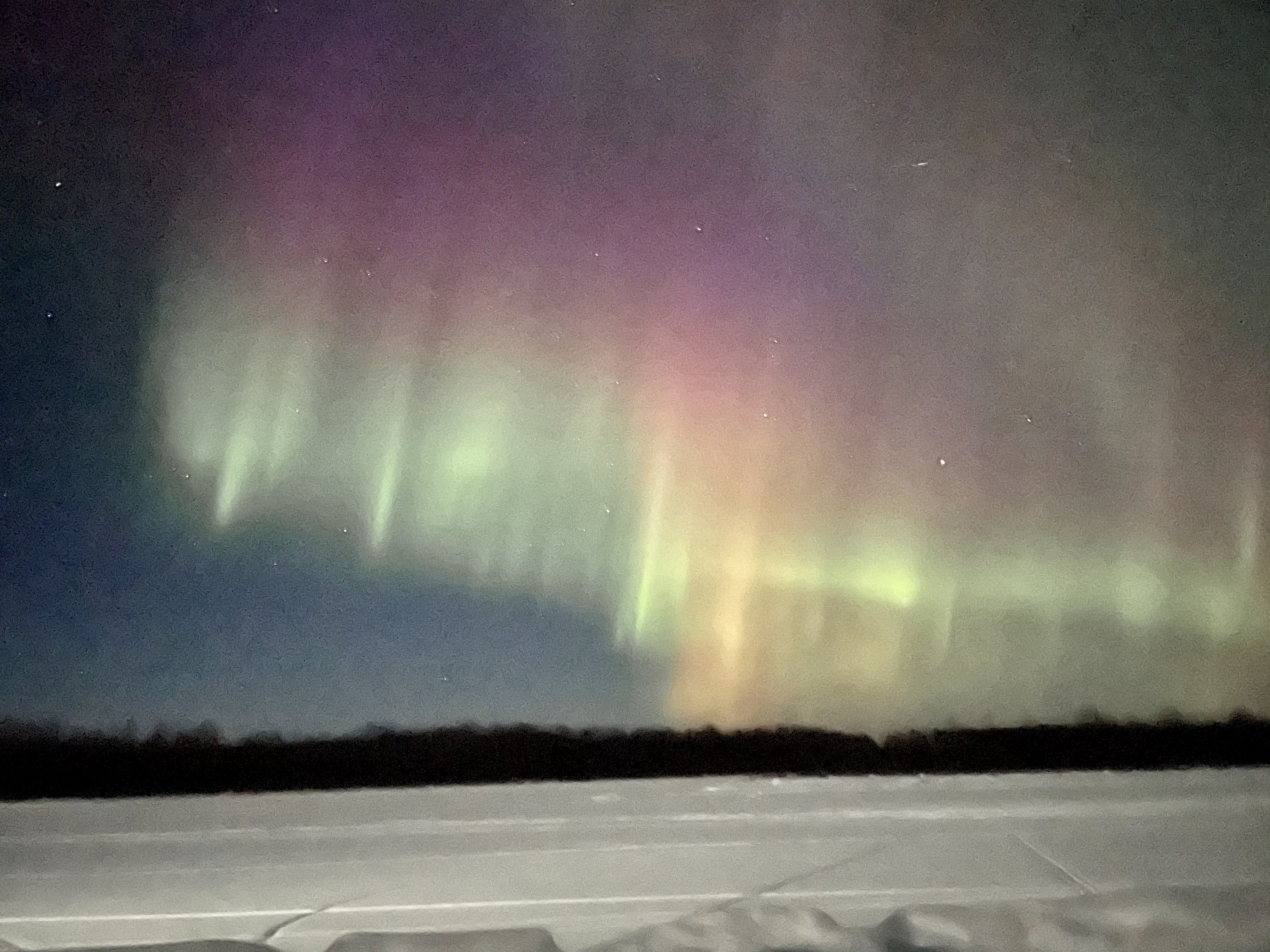
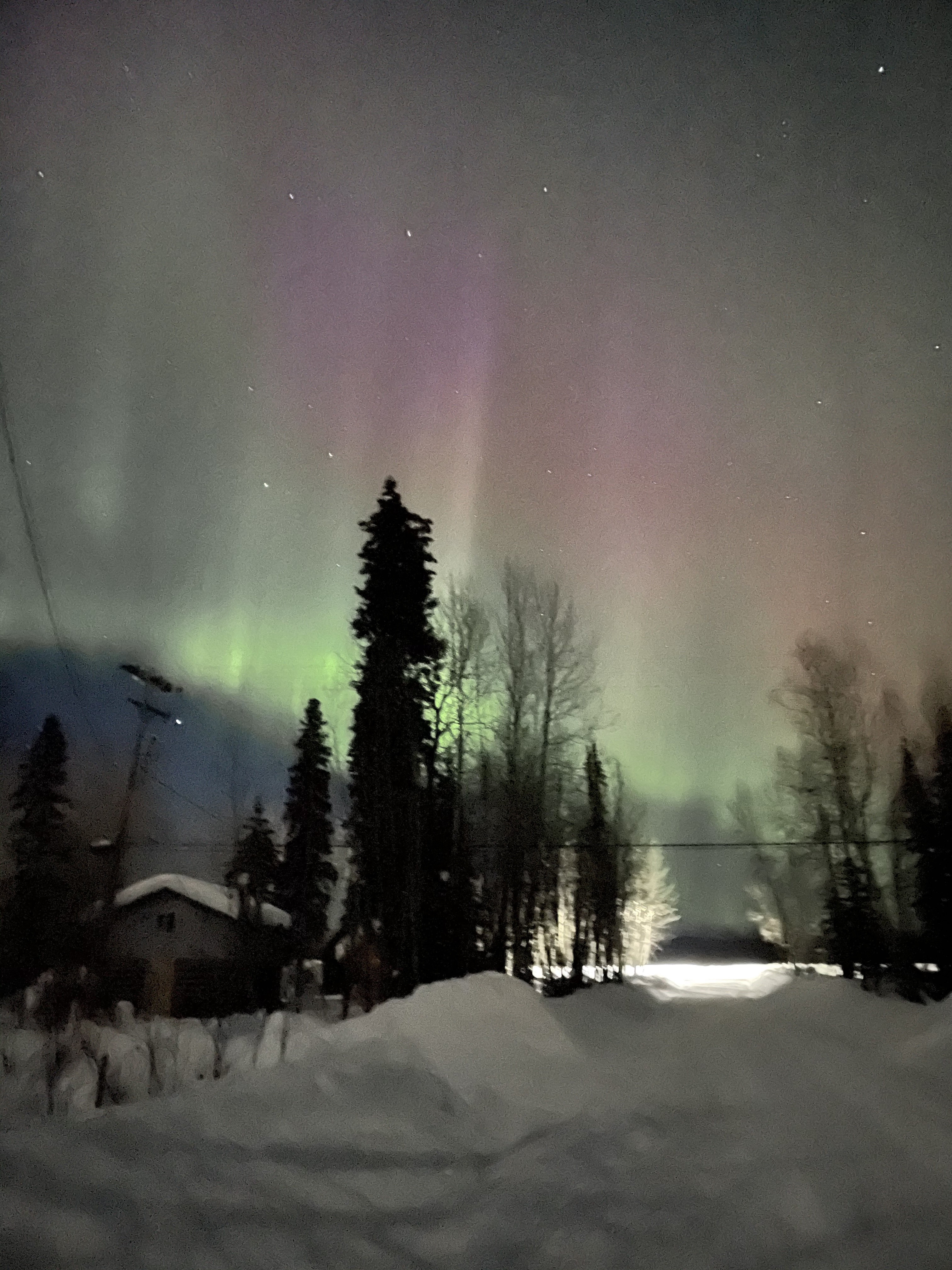
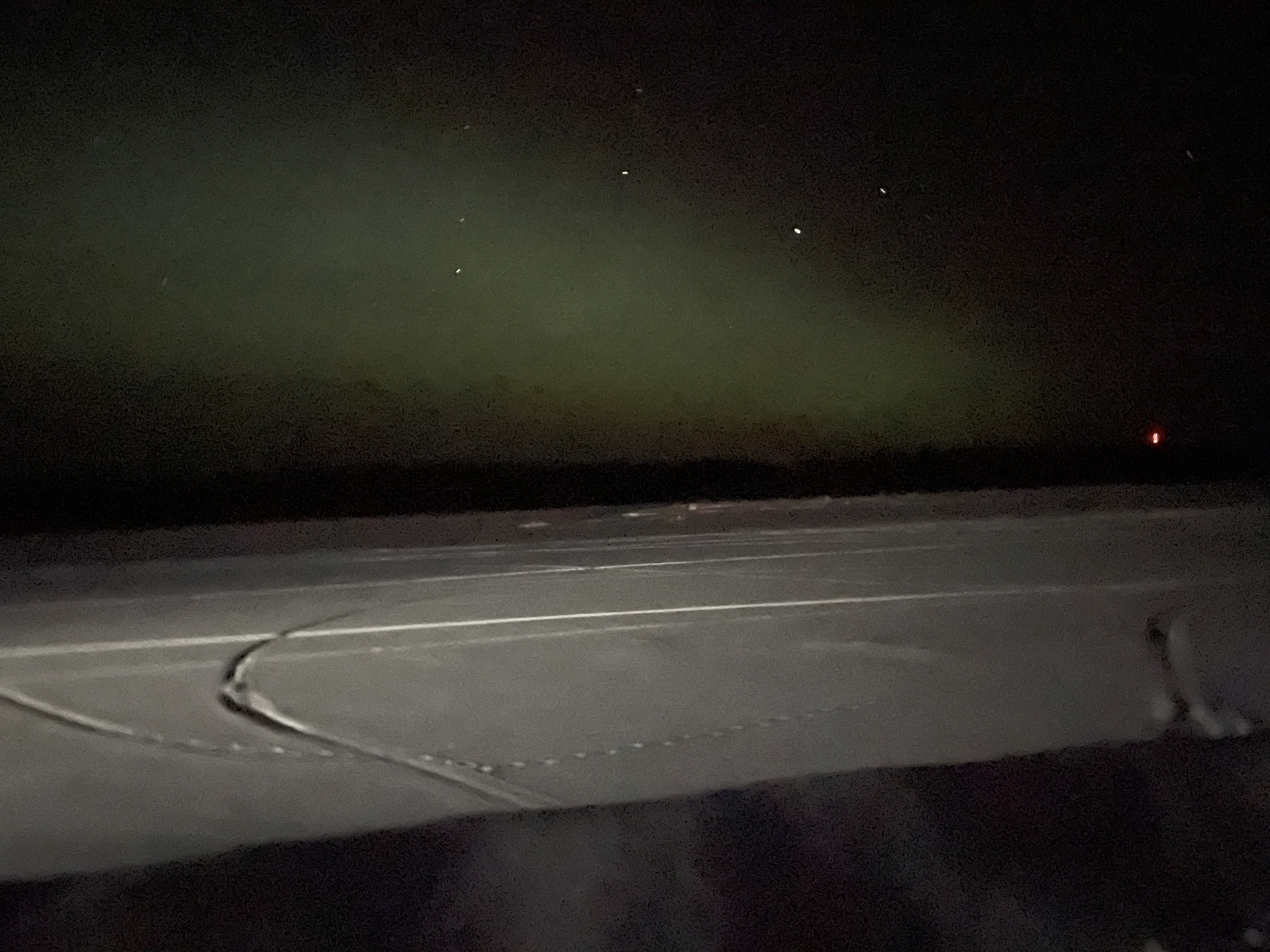
It seems I start waiting for vernal equinox the day after the autumnal equinox. In McGrath today we have twelve hours and eighteen minutes of daylight. At 62°56’59”N latitude, I doubt anyone reading this is farther north. So from now until September 20th, you all have less daylight than here.
Because Alaska only has one time zone except for the Hawaii-Aleutian Zone at the tip of the Aleutian chain, most resident’s daylight comes late and lasts late. For us waiting to view the northern lights this puts us outside way late. Last night it was 10:30, way past our bedtime. I still woke up at 4:00 time for more northern lights.
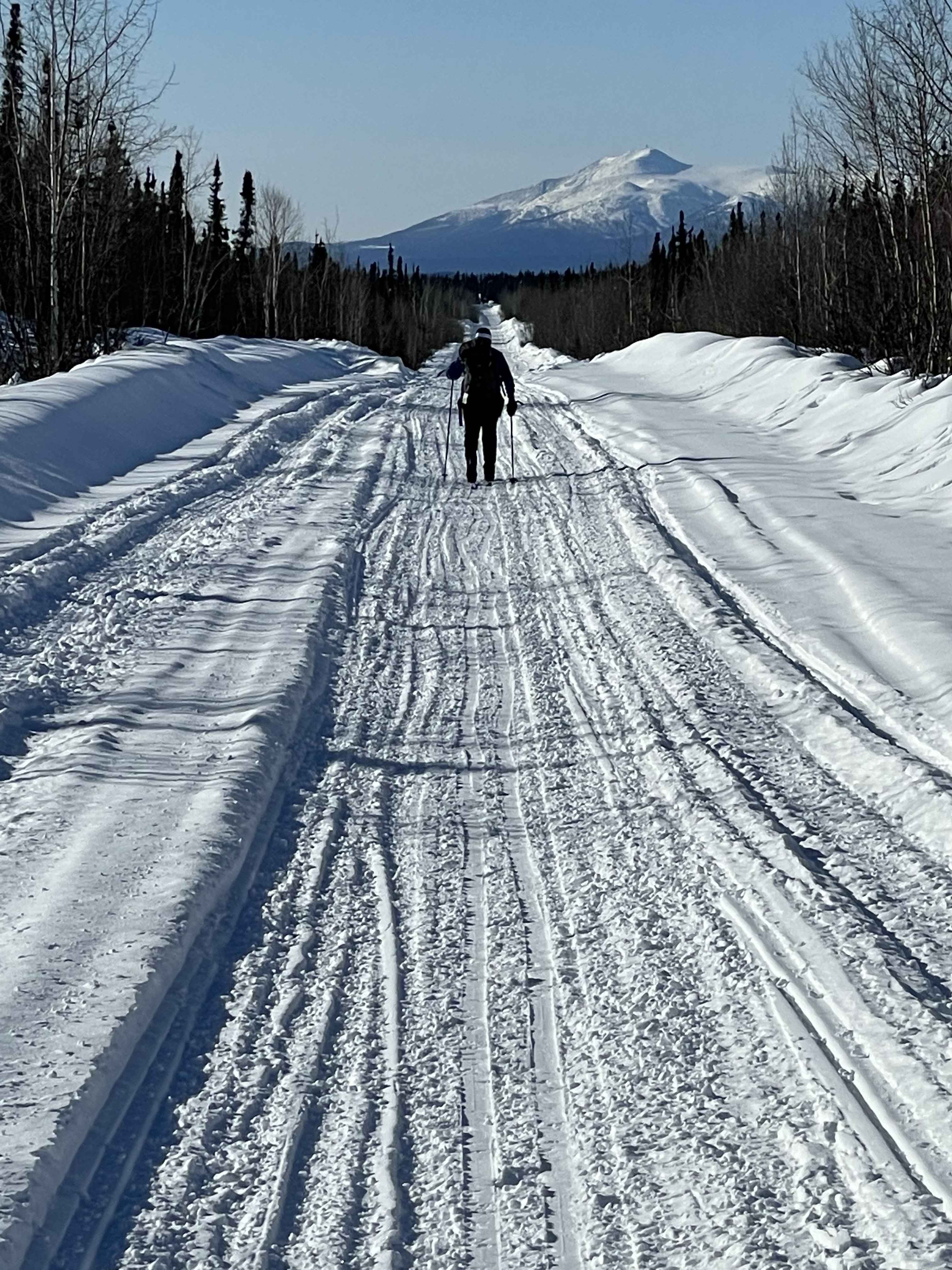
We alway hike on the equinox. Here, if you hike 10 miles on the road to nowhere, you get a good view of Denali. It was an ambitious plan. We couldn’t leave our house until 12:30 for two reasons. # 1 it didn’t get above zero until then. And #2 We were waiting for a report on last night’s NAC attack. In other words waiting on the veggies.
We did run out of time. It was too hard in the snow to make fast progress. We ended up completing fourteen.
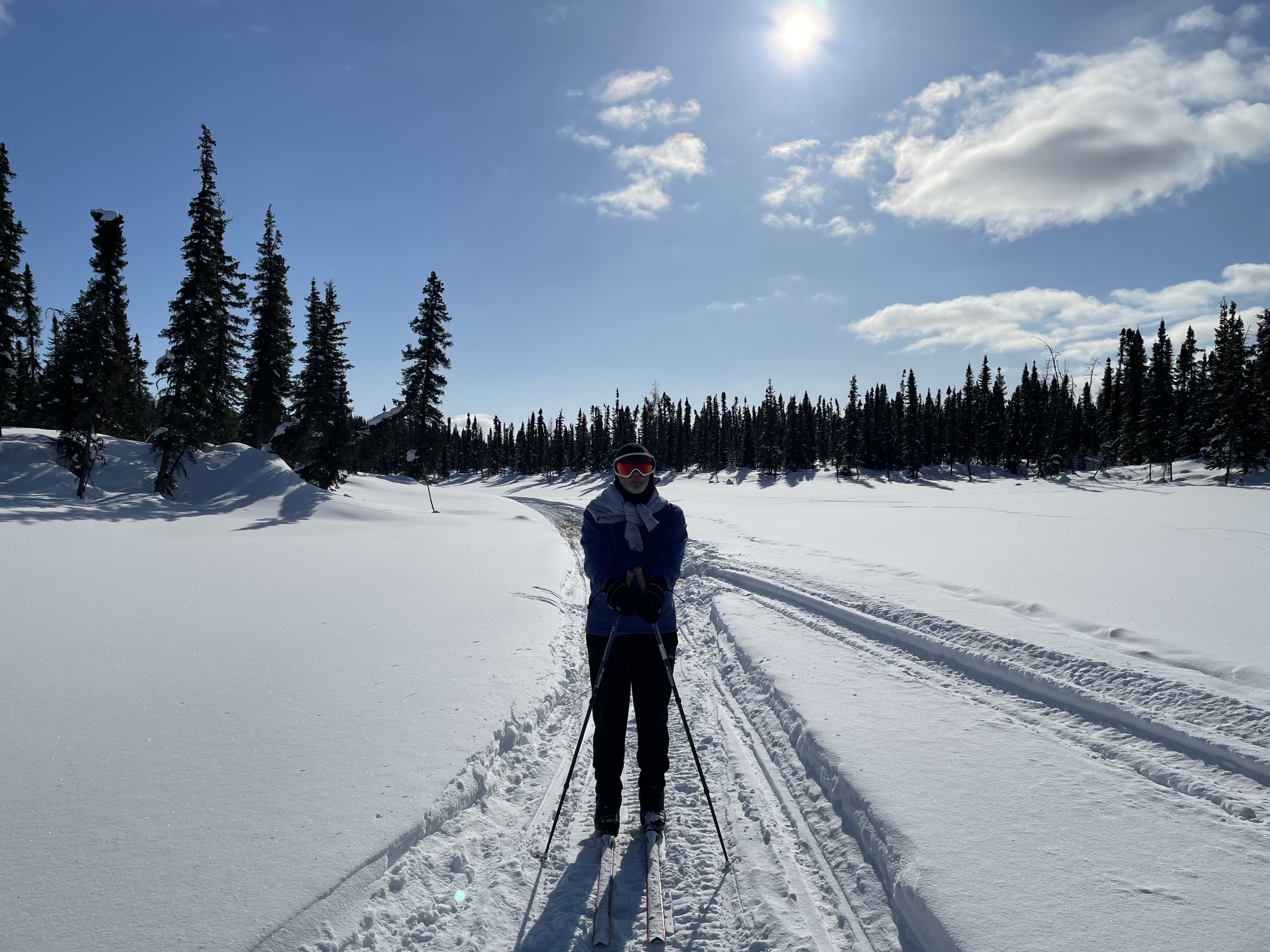
Terry in his skis and I, not shown, in my cap without a jacket but with extremely painful winter running shoes with too many pairs of socks and plastic bags.
Down the street the dogs are barkin’ And the day is a-gettin’ dark As the night comes in a-fallin’ The dogs ‘ll lose their bark And the silent night will shatter From the sounds inside my mind As I’m one too many mornings And a thousand miles behind
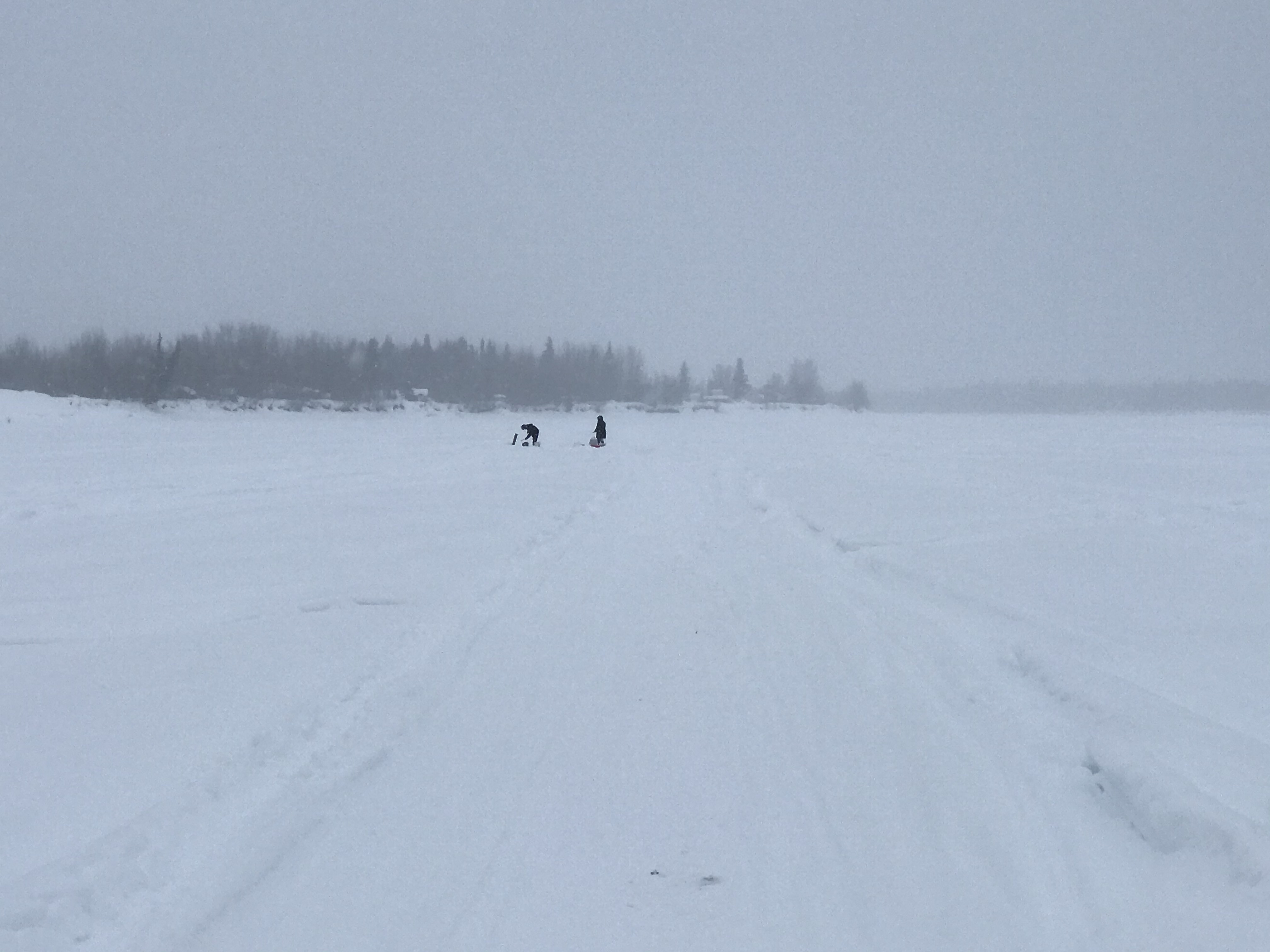
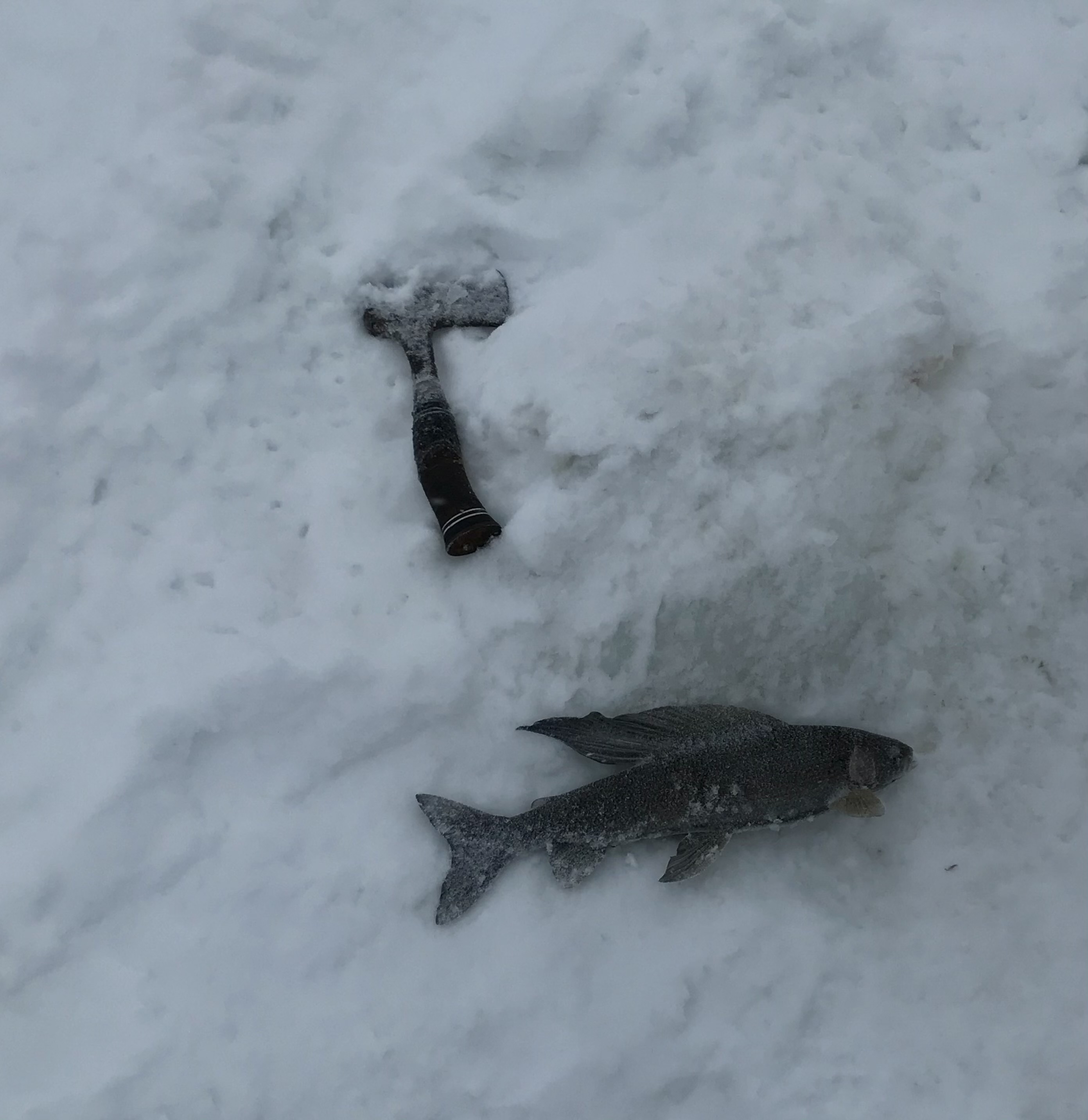
The day gets swallowed by small detail. We stood and watched the fishing holes, as the two women fished. One standing over her hole in the ice holding her broken fishing pole with an imitation reel carved by her husband that she you used to wind the fishing line around. Baited with meat, she jigged it up and down. She talked in a calm soothing voice to her dog friend who has come down for years to hang out and investigate the holes. A nice sized Grayling tugged on her line as we talked and she yanked it through the hole. The dog, too, remained patient and calm even when she sensed a ghost.
The other woman, who is feisty and doesn’t know how to slow her metabolism, which is making her remain thin, tells us about a woman coming home from the bar, who flipped her snow machine over onto herself. No one knew about it until morning. A couple in their house heard something but didn’t check and the woman was found dead.
A dog knows when the dead woman is close. Someone saw her beckoning them to join her.
After spending a night in the haunted house in St. Louis MO, I can attest to the fact that people see ghosts. I literally saw them seeing ghosts.
The skinny woman was telling the story of doing house keeping for Davis-Bacon wages, $40.00 per hour. Maybe she was making the high wages because she saw a ghost there. The dog alerted her. I must confess I love stories about dogs hearing and seeing ghosts.
Mukluk used to growl and back up when we ran in the dark. He’d see something. It usually looked like a garbage can to me. But how can we assume we know more than a dog? Their sense of smell acuity is between 10,000 to 100,000 times greater than humans. How do they even manage it? The dogs here have their own Morse code. It travels all night alerting. The two women know the woman in Grayling who gave us Mukluk. Small world.
We learned a lot in two hours out on the ice with one elder and a near elder. The elder gave me her DOB as 4/1/1959. She said she wasn’t sure of her age, so she was telling everyone she was 65. Sometimes we are so uptight about those numbers. Where does that get us?
Once again, at sunrise there are 2 figures, out on the Kuskokwim River ice, bent low. Deb and I take a detour to check it out. Two local women, not young, are jigging their lines up and down.
One has a bunch of monofilament snarled around a wooden ladle. The other has a piece of wood carved to look like a child’s fishing pole. Between them they have caught a single Grayling in 3 days of fishing. But they are content. Both love fishing, and for them it is unrelated to catching anything. Eva fishes with a piece of macaroni, while Margaret bobs a small chunk of leftover moose pot roast.
The holes have been augured by a man who is preparing for students to have a day fishing. There are 10 students, thus 10 holes. Each is 12 inches in diameter through 4 feet of ice that lays on about 8 feet of river water. Eva said the students will have the good bait, shrimp. We will be there observing and hope to have pictures of whitefish and northern pike.
The museum has been calling us. Today was the first open day after quarantine. Two former high school teachers work there. It is a wonderful repository of local history. They also have every local animal, from a vole up to a wolf. And a large collection of mastedon tusks and teeth.
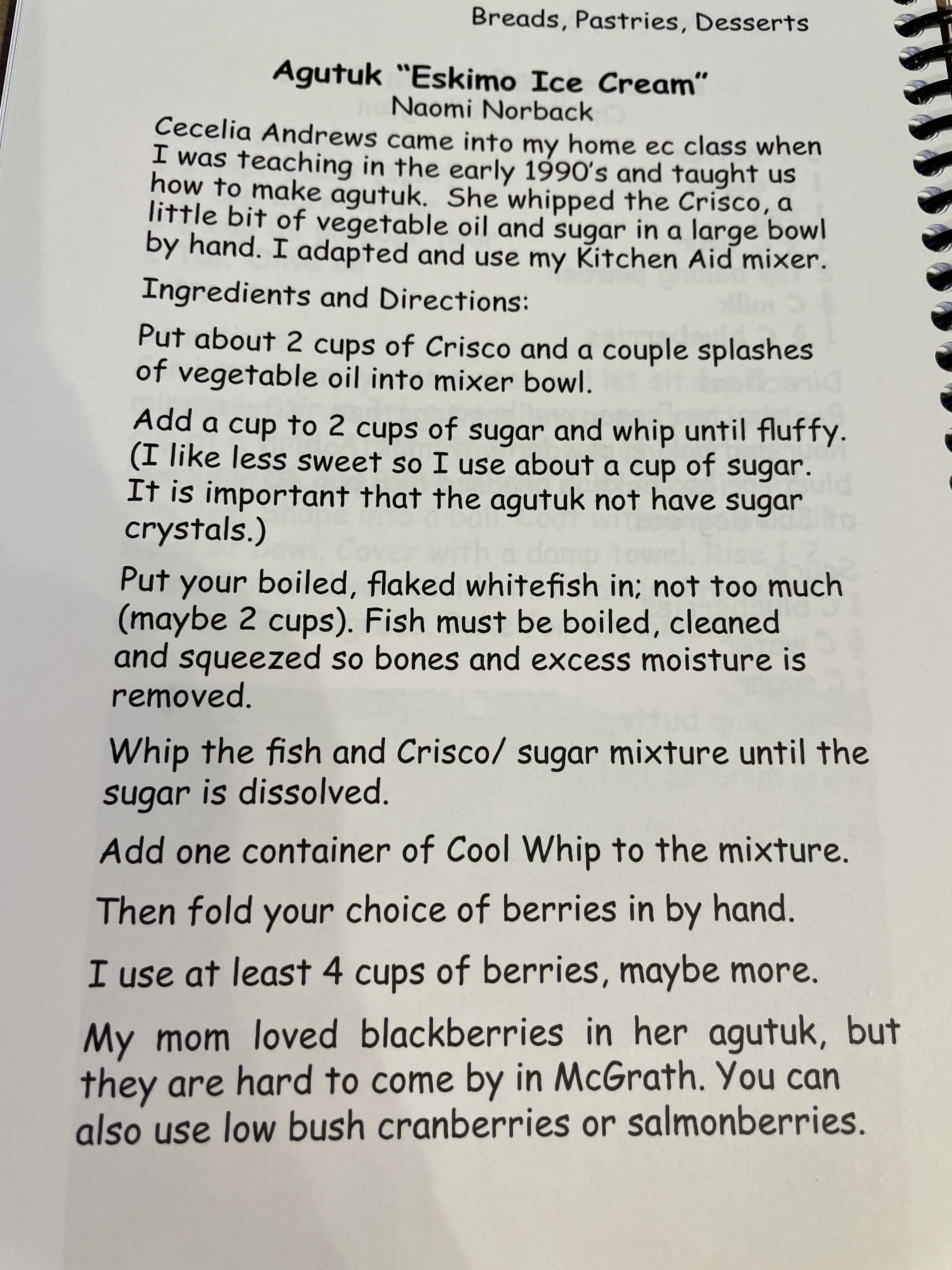
I bought a local cookbook autographed by the staff who compiled it.
This is a recipe we’ll make for you all on our return.
Margaret is a local photographer. She grew up in Nikolai a village of 75 people 58 miles from here. You can get there by snow machine, boat, plane or dogsled. She said she was both Athabaskan and Yupik. I don’t want to use derogatory terms but Athabaskans are interior Natives and are considered Indians, and Yupik are coastal Natives and are considered Eskimos (which is a derogatory term). She kind of chuckled and said, “you know they are not supposed to get along.”
She pulls her camera equipment around town in the best sled we’ve seen here. She’s been encouraging me to visit both the museum and the McGrath Light and Power office to see her work. With quarantine over, we headed to the electric company office. The only office employee there, a man named Ralph, 29 years old, turned out to be Margaret’s son. Margaret is married to Ralph the mayor. Despite any possible favors from either Ralphs, she had a great shot of two owls, a beaver, and Denali.
It warmed from -6 to 19. A good day to get out on the river. Terry on ski and me winter running shoes. No balaclava, mittens or large jacket. Easier to move and breathe. We found two booties one we could extricate from the ice and the other embedded frozen evidence for the future to postulate on what we were doing to our dogs.
We hoped to get four miles up river, but at three miles we ran into overflow ice and after trying to walk gingerly with spayed toes inside my shoes, and intentional breathing slowly, I’d had enough. The ice is 40 inches thick, so I wasn’t worried about going under, but getting shoes and socks submerged would not be good.
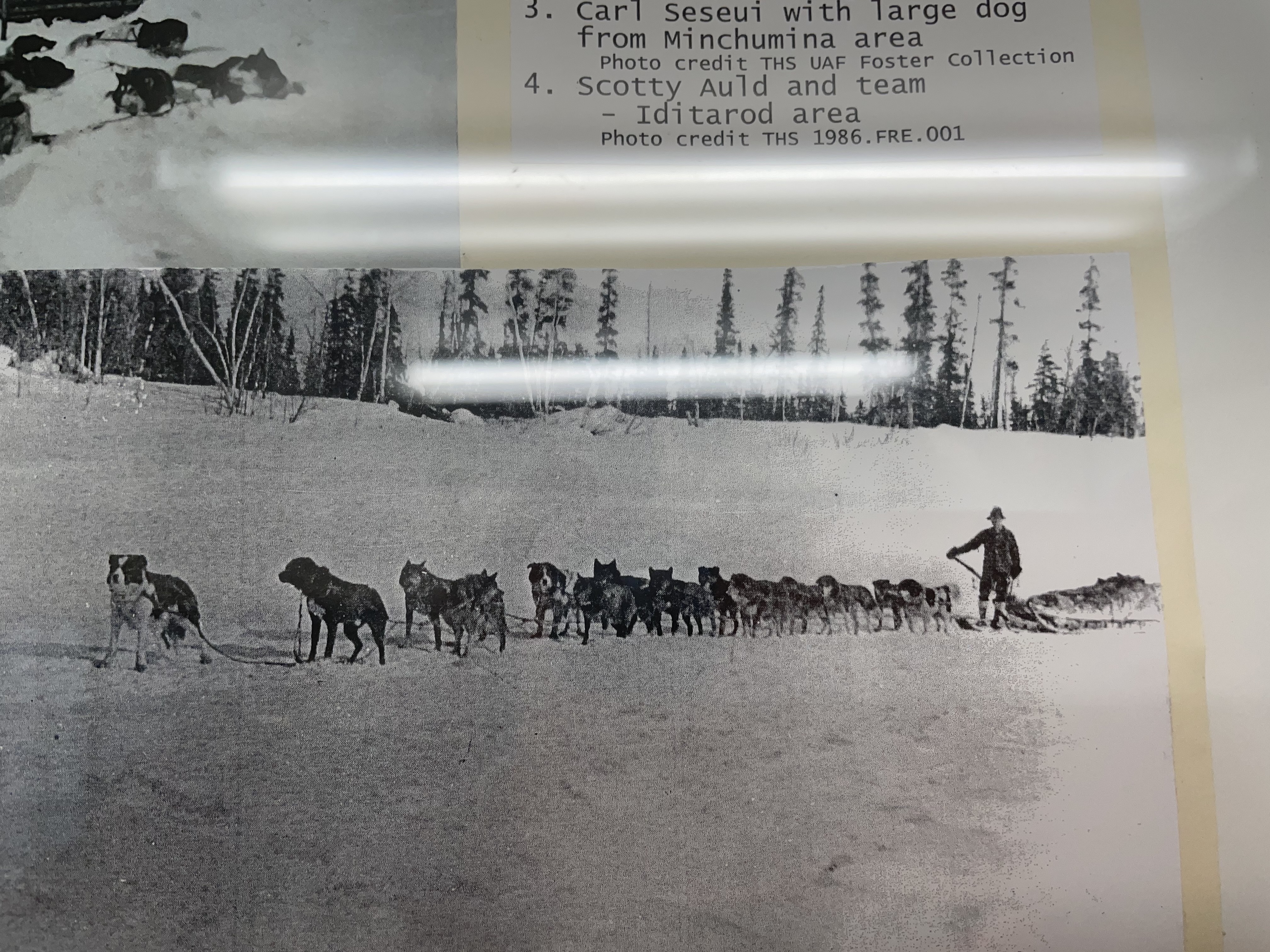
This is a picture from the post office. Can you see the lead dog?
Closer to town, a plane appeared to be buzzing us. It had the blue and yellow colors of Alaska on the bottom. It was the State Trooper’s plane, our landlord. He dipped his wings to wave.
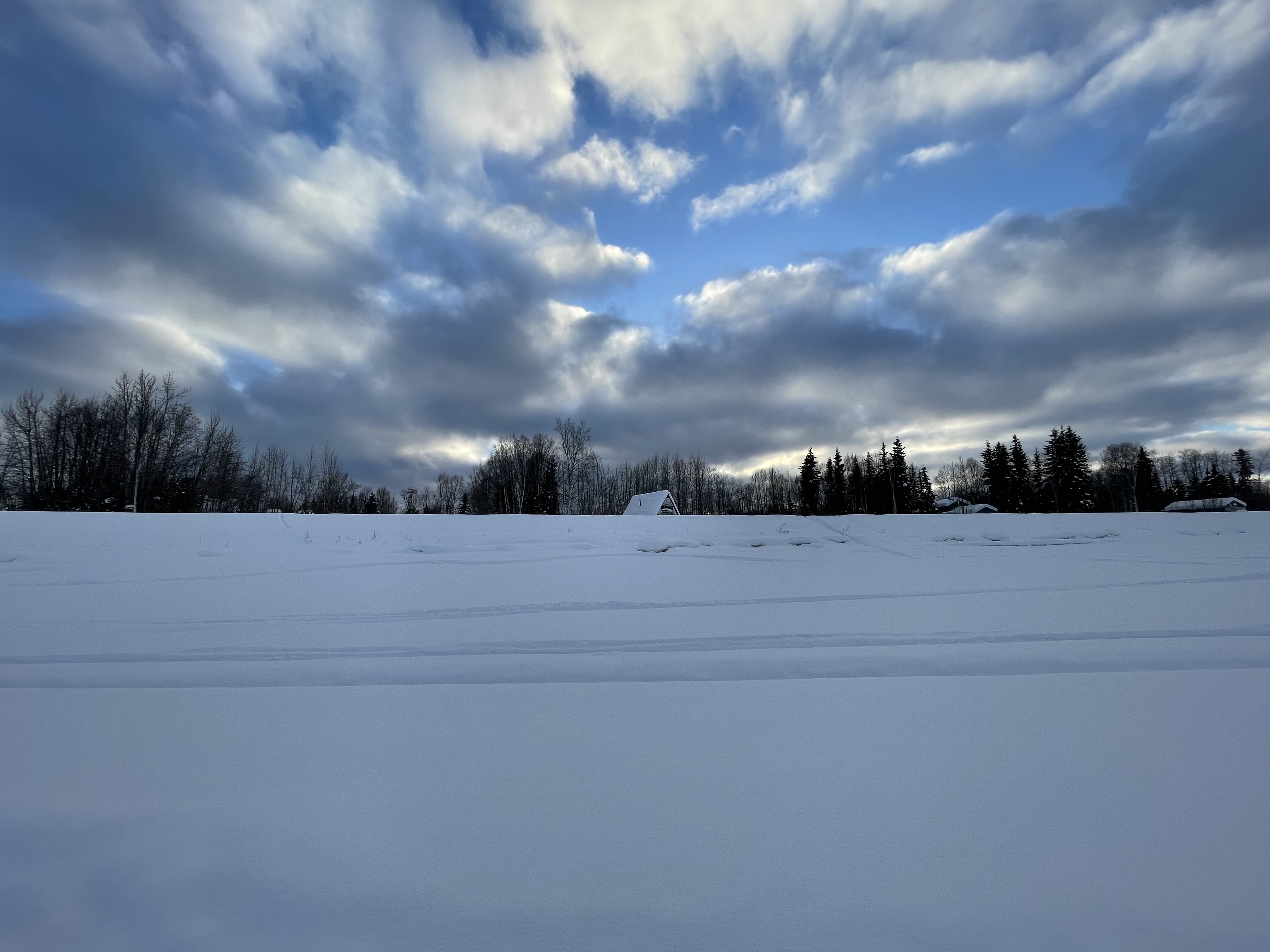
The river is quiet. The orange tipped stakes are the only visible remains of the Iditarod Trail. A fresh coat of snow hides dog excrement. The telltale signs of 600 dogs. We didn’t see any fishing or snow machining. This was the last event before break up. As the snow stops falling and the junk that lies beneath the white blanket prevails the complexion of the town is transformed from winter wonderland to a continuous junk yard. We’ll miss out on that part. Our memories will look beautiful. We fly out of here on March 31 and arrive back home on Poisson d’Avril.
It was 3 above in the morning and reached 16 above during my run/walk accompanying Terry skiing. I didn’t need a jacket or gloves.
Terry left his quarantine and went straight to the store. It was great for him to be out of my shadow and have freedom to buy what he longed for and see new masked faces up close.
Dallas Seavey was born in Virginia and his family moved back to Seward when he was five. He is a third generation musher who grew up helping his dad, Mitch, the 2004/2013/2018 Iditarod champion, train his racing teams. He ran the Jr. Iditarod four times and in 2005, Dallas became the youngest musher in history to run the Iditarod. He also wrestled for Sky View High School and spent one year training at the U.S. Olympic Training Center. He is a High School State Champion, a Jr. National Champion, and was on the 2005 Jr. World team. In 2011, he won the Yukon Quest and in 2012, he became the youngest Iditarod champion in its history. He is one of four mushers ever to hold a championship in both the Yukon Quest.
The last mushers have turned toward the finish in Deshka Landing, but there is still plenty going on in McGrath.
In spite of toe tingling temperatures, spring is bearing down. Ravens are pairing and gathering nesting material. They fly some crazy patterns and emit a wide range of sounds, around 280 different vocalizations ranging from a telephone ring to caw caw. There was a giant unkindness, term for a group of ravens, of them going crazy at the site of mushers’ straw. Discarded trail booties have become impossible to find, probably becoming part of raven’s nest also.
Poplars set buds last fall, those not munched by moose, are sneakily extending, hour by hour.
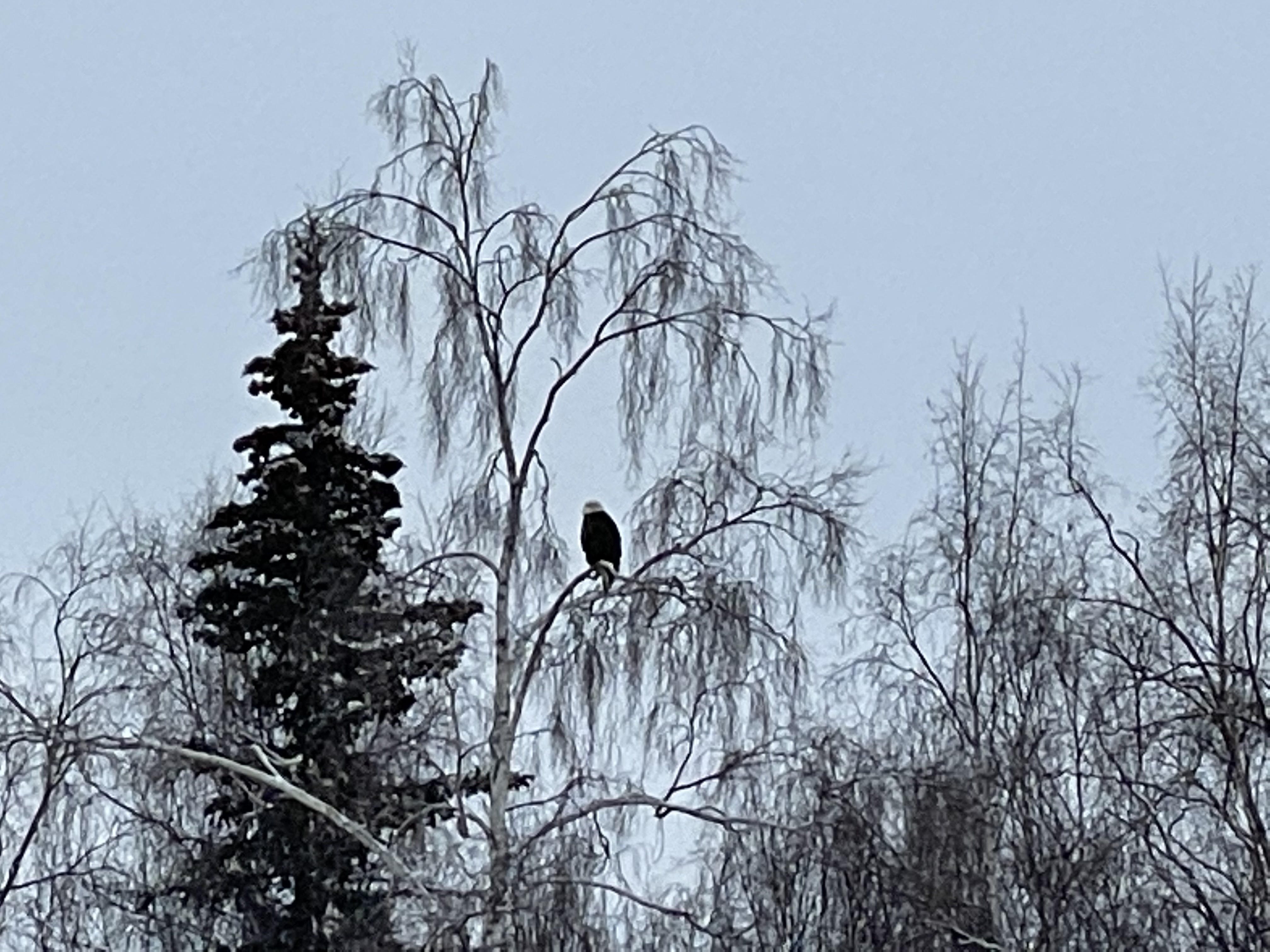
Earlier today, in the pre-dawn hours, Deb heard the haunting call of the northern hawk owl. It does not migrate, subsisting on squirrels and various rodents. Also we spotted an early bald eagle, motionless, saving energy, being swooped on by adventurous ravens.
The bald eagle is an uncommon sight this time of the year.
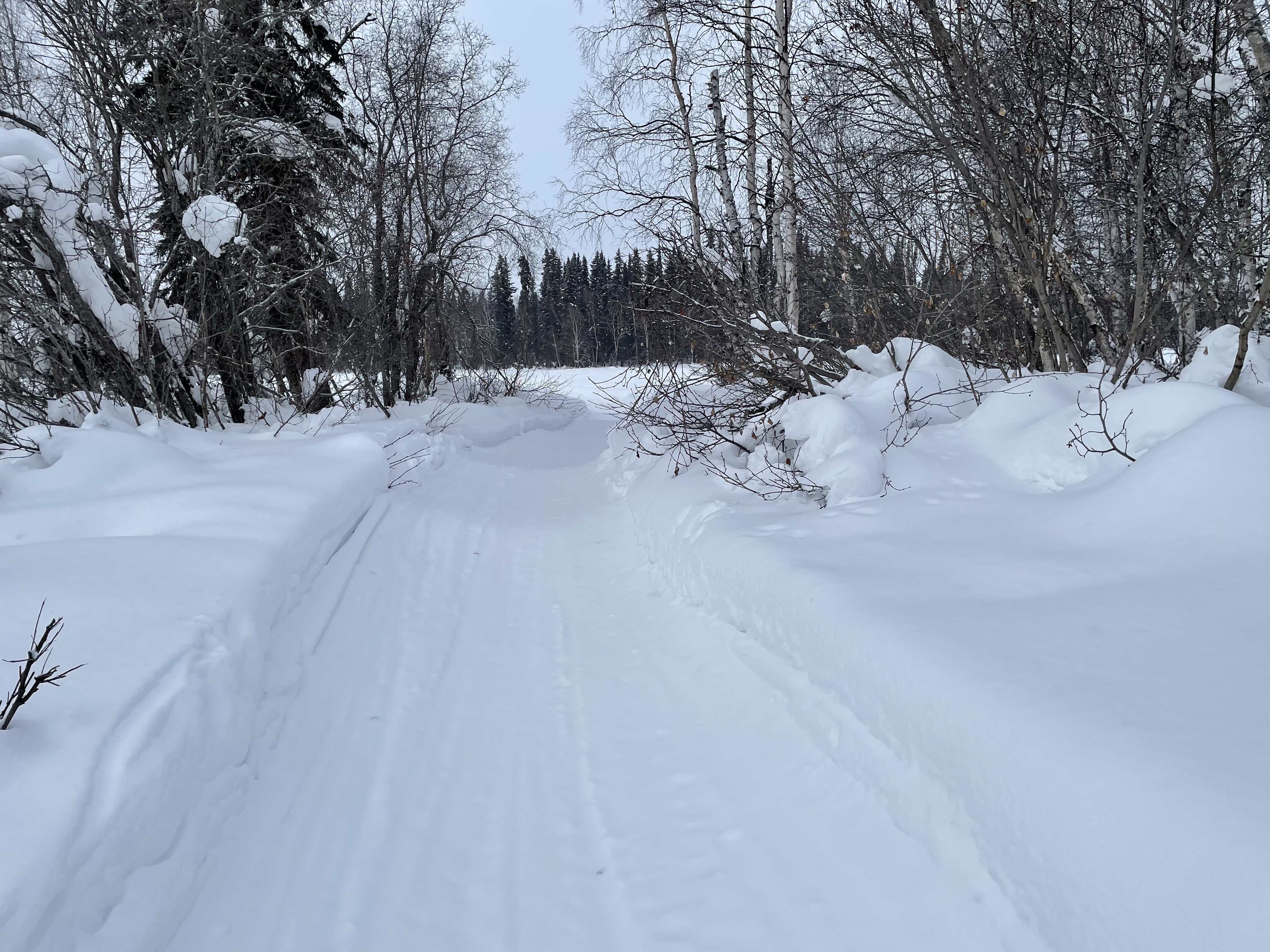
All mushers and teams were out of McGrath by mid day. We were free to pick around on the other side of the Mushers, encampment. We followed the trail for a ways up the Kuskokwim to the Takotna River. This wends it’s way through narrow land bridges with winding trails through the trees. Perfect skiing. But my boots are unusable. We had wanted to ski to the village of Takotna 18 miles away. I could walk and watch Terry ski, but with Covid there’s no place to stay. I love the idea of snow camping, but not below zero. Maybe if we have time, we’ll go farther on this trail.
Iditarod trail on the Takotna River good for skiing.
We’ve been glued to the Iditarod Leaderboard. It’s a tight race.
Despite the blackness, I see a mist hover above the ice in a distance. Is it black out or just an absence of anything to see? There it is, a flick of light and then a short stream skimming the surface of ice. This streamer. Catching one at a time. A faint knowledge of paws turning as graceful as Amanda Gordon’s hands. A bird’s flutter. Pattering paws so far away, they sound of exhalations, a mire whisper in time. When that moving dog-powered sled is mid-ship of me, it is haloed in green Aurora. Remember the mystical.
The ballet I was watching at 5:00 am was Paige Drobny’s as she was slipping quietly away from McGrath. She spent the night with her dogs as she did the three previous nights. The night they were in Ophir it was -55. I know mushers have to barehand a number of their chores. How do they do it?
Biography
Paige Drobny, 45, was born in Bryn Mawr, Pennsylvania, and says she moved all over growing up. She graduated from Virginia Tech in 1997 with her B.S. in Biology and from UAF in 2008 with her M.S. in Fisheries Oceanography. Before moving to Fairbanks in 2005 for graduate school, she lived in Colorado and was a fisheries biologist. “I enjoy the outdoor lifestyle. I work as a fishery biologist and help my husband, Cody Strathe, build dogsleds for our company, DogPaddle Designs, during the summer. Our mushing started in 2006 as a way to explore the wilds of Alaska with no plan to ever do any racing. We spent several years camping and traveling with our dogs. In 2010, Cody and I decided to give it a whirl and entered the GinGin 200 together…we had a blast, and suddenly we were on the slippery slope.” Paige has run the Iditarod five times
It’s -36 degrees. I’m not going to linger, the experience will. Back in the cabin, I sit on the mattress in the loft. I set my intention, and start writing this. It’s 75 degrees inside.
The 2021 Iditarod will be over for us by tomorrow afternoon. And the winners will be determined soon. Will I ever see another Iditarod? I hope I’ll remember what it meant to me.
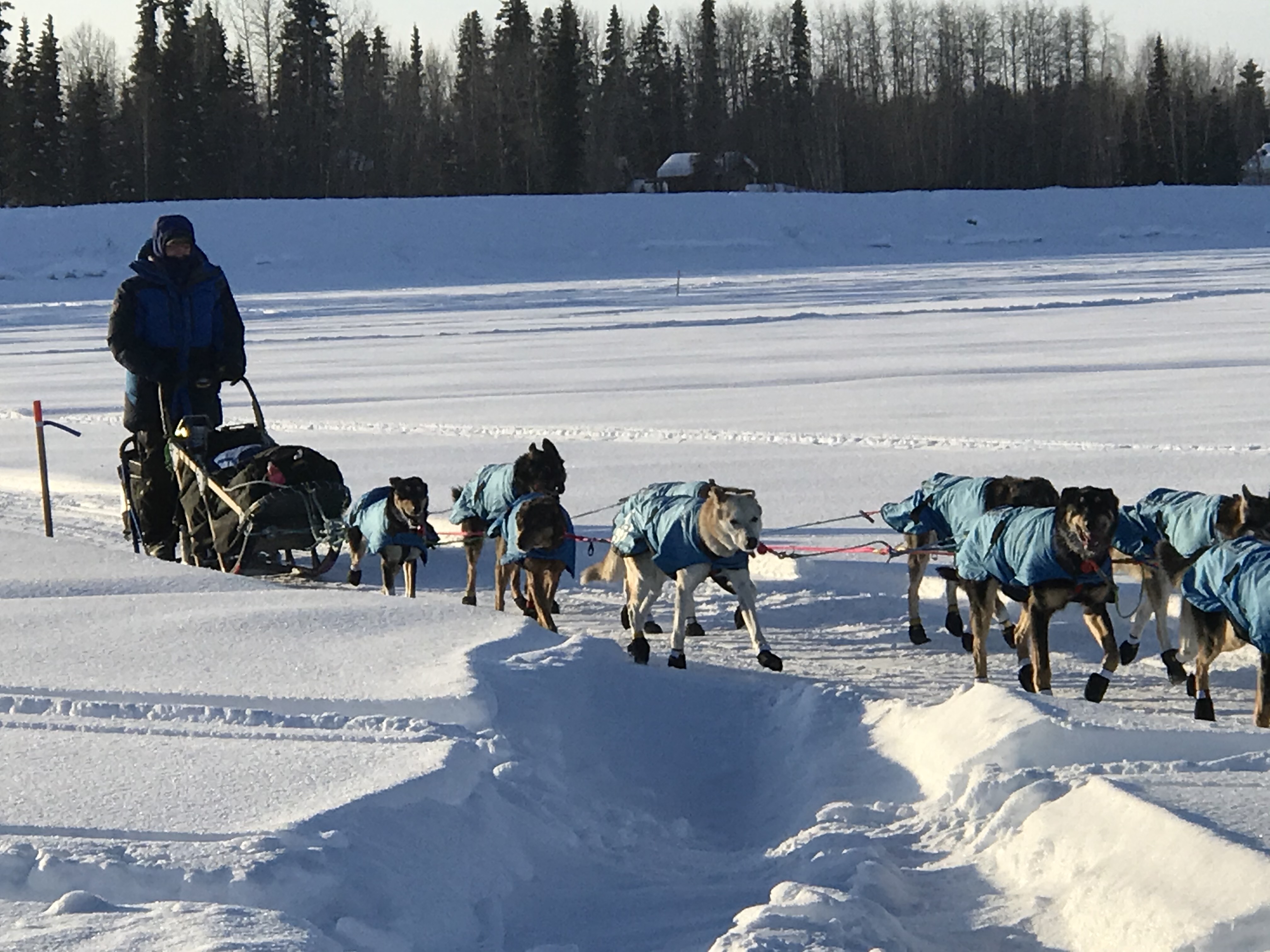
You know it’s cold when the dogs wear their parkas. These are Chad Stoddard’s dogs leaving McGrath at 5:34 PM.
At -34 temperature in the dark, at 4:30 AM, I head to the river bank. It’s only a 50 yard walk. Our landlord had texted last night at 10:30 that the northern lights were out. I read the text at 4:00 am. Who’s up at 10:30 pm? Before leaving the house, I checked the tracker and a couple of mushers in Ophir’s -55 temperature were heading back to McGrath. Mushers don’t usually complain about cold, but they were this morning. Dallas Seavey was ahead. It was clear he’d be back in McGrath this morning.
The Aurora was disappointing. But the quiet and stars were worth the jaunt.
Every morning I wake about 2 hours before Terry. Under headlight glow, I make coffee, gather my laptop and books and teeter up the ladder. The loft is warm. I sit on a mattress on the floor and set my laptop on a bed stand. Now the sun comes early enough that it will grace me before Terry does. I love this space.
When the sun sheds its first light, I reached up to remove my headlamp and the elastic string wound up a clump of hair near my forehead. I heard Terry rising. Help! He patiently tried to unravel it, but the scissors had to be employed.
Our morning brings many futile efforts. We both will need Covid tests to leave here. The clinic’s phone has been down for two days, nevertheless, we keep trying the number. Our Full Circle veggies due Wednesday did not arrive, old story, but we repeatedly check the message board. Even though everyone I know has receive their Covid shots, I can’t get an appointment, but I continue calling around Santa Cruz county venues. Just bothersome problems.
We watch the progress of Seavey – he’s getting close. Coming from the west into McGrath, we lack a viewpoint to watch mushers arrive, but Terry wants to go down to the ice and then he can search for more booties. We underestimate how fast Seavey is traveling, bingo he’s in. We guess that he’ll take his mandatory 8 hour rest, so this frees us to do chores until 5:30 when we can watch him leave.
Dragging the sled to the incinerator with our week’s garbage, the packed snow crunches and squeaks. Returning we notice NAC has made an attack. NAC is the Northern Air Cargo jet that arrives on an unpredictable schedule. Locals call it a NAC attack. It’s impressive to see the lumbering 727 jet rising over this tiny village. Will we have veggies and mail today?
No word for three hours, then suddenly it is on the message board. We head straight away to the terminal and sled two boxes home, trying to beat the freeze. PO closes at 5:00. We make it with 2 minutes to spare. We have a box of homemade cookies from Sue Walkup. Thanks so much. Now we have to make it down to the river to see Seavey leave. And there he comes.
Homemade low sugar, high cocoa chocolate chip cookies from Sue Walkup ❤️
At 9:30 PM, we’re back on the river bank watching the headlamp of Brent Sass illuminating the churning paws of his team with a green ribbon of norther lights on the horizon. And the real race begins.