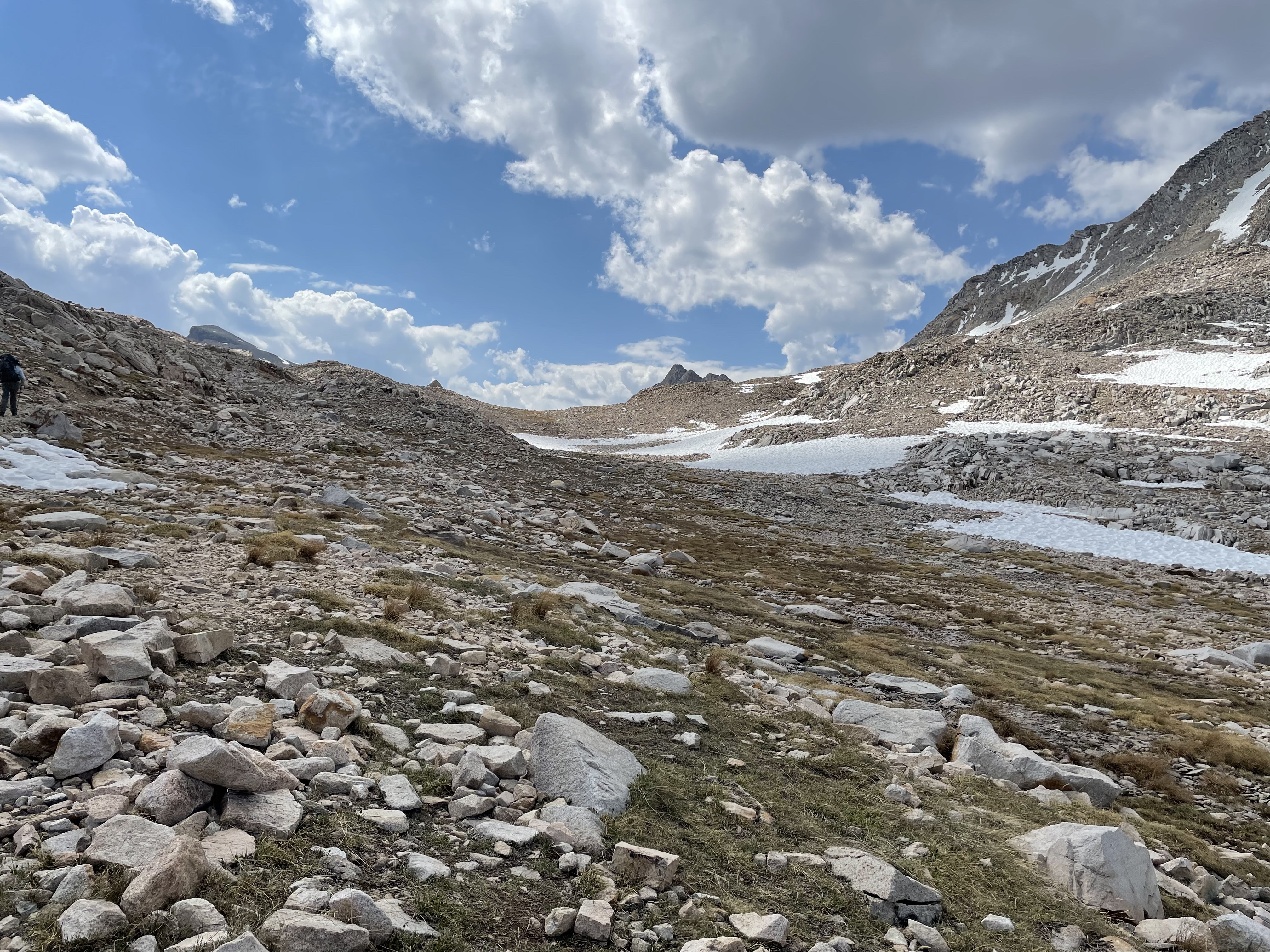
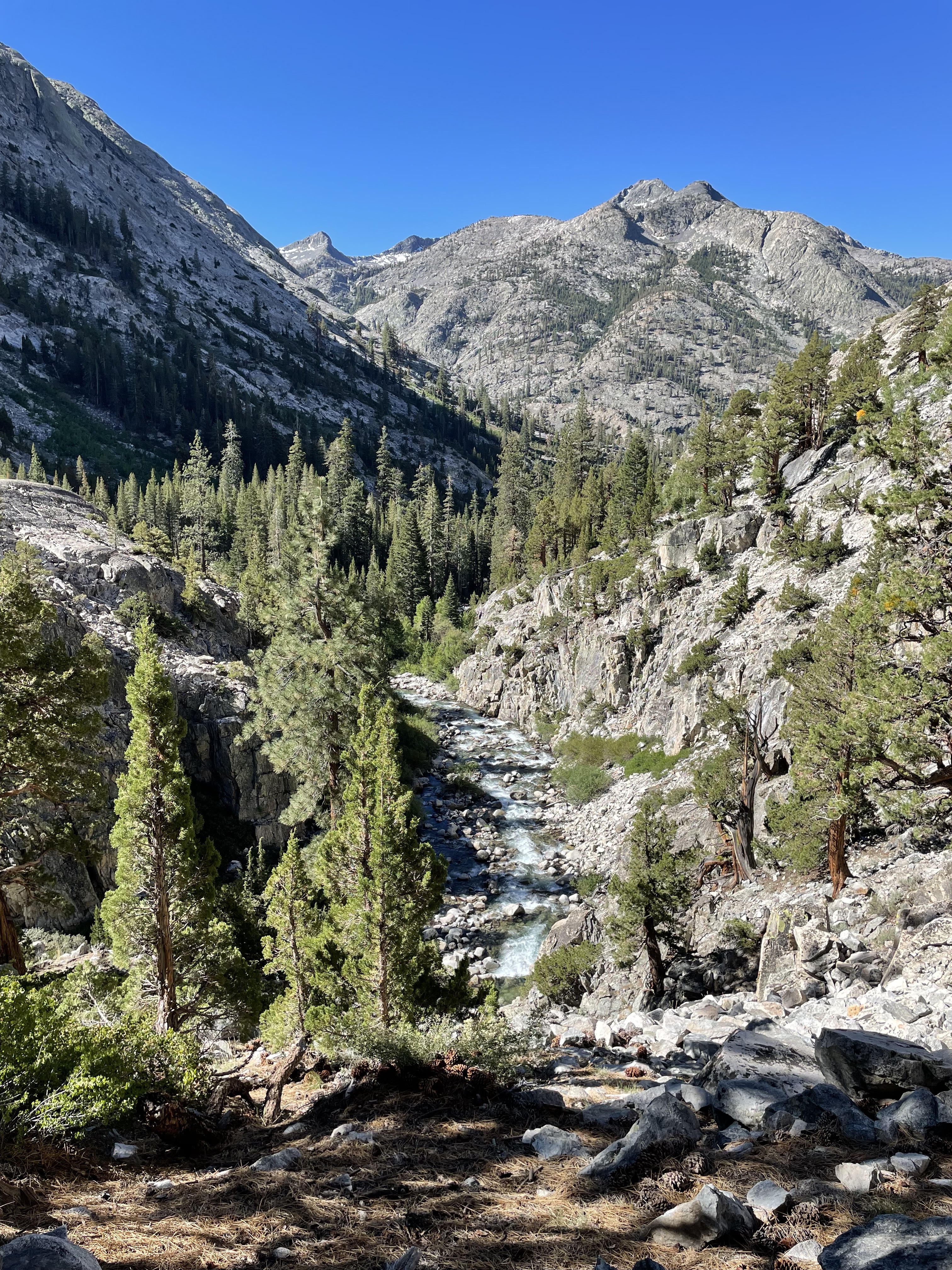
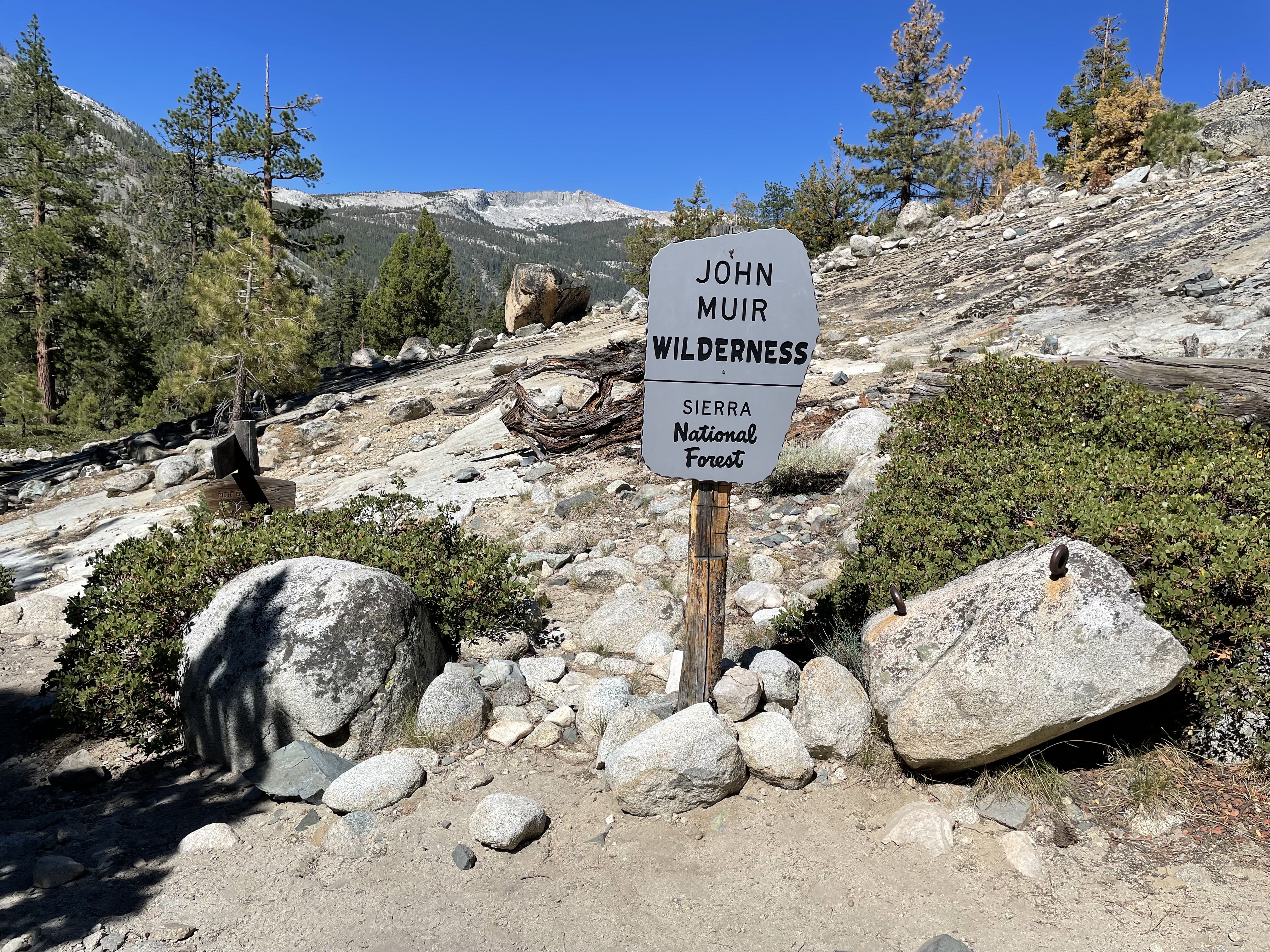
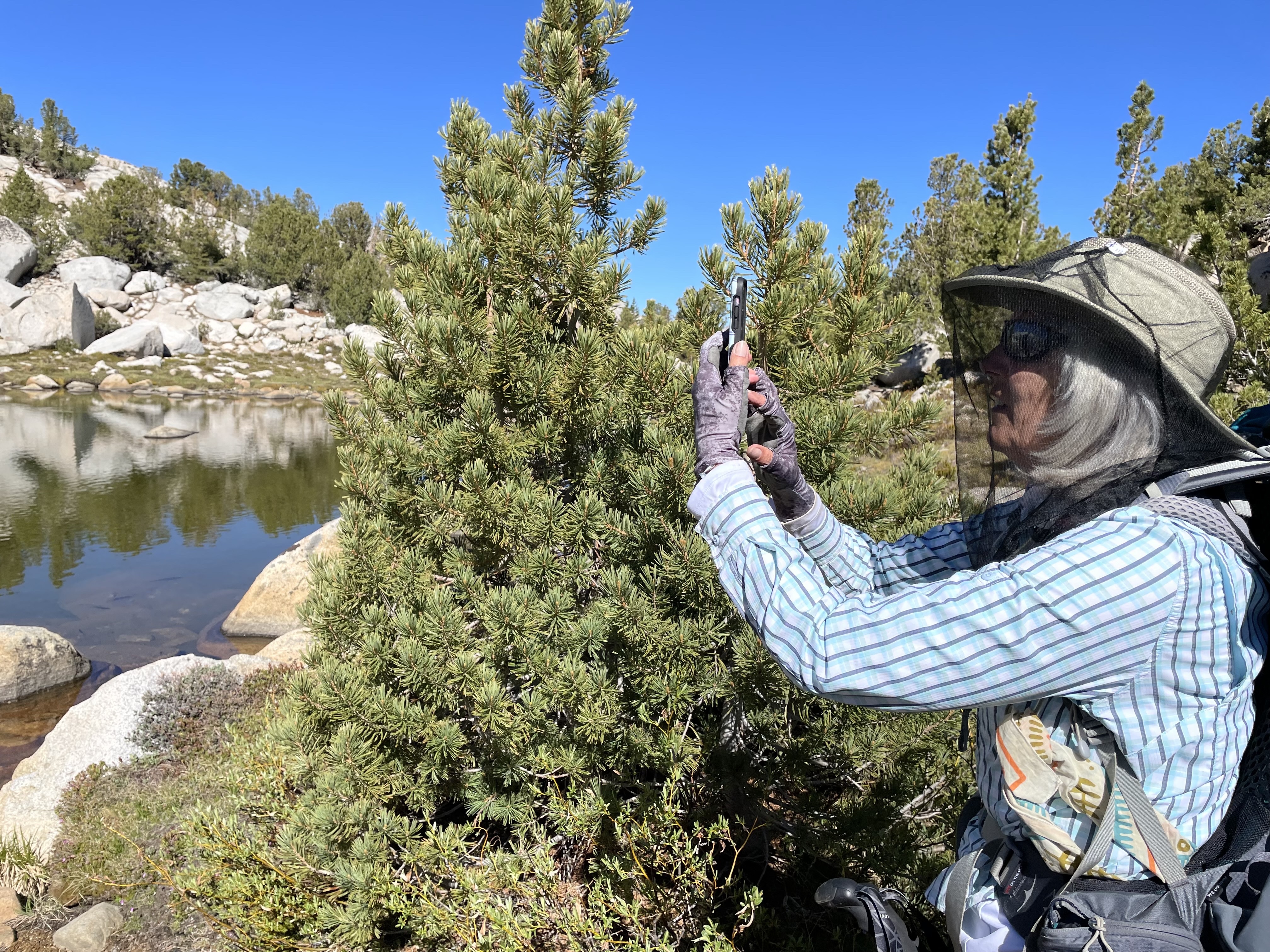
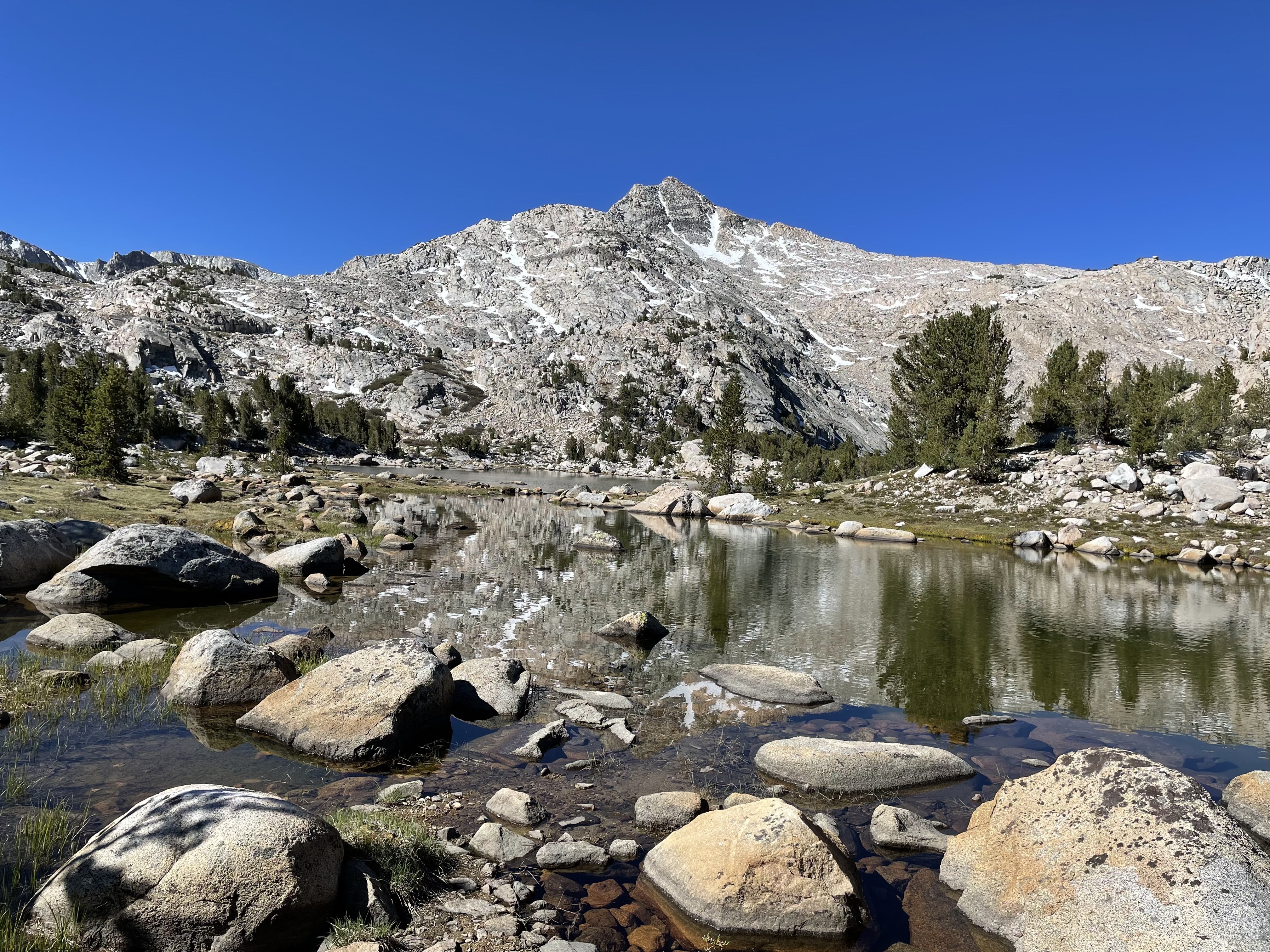
We left the trees behind at Evolution Lake. Our landscape was high elevation granite dotted with lakes and covered in rock rubble. From back at the Evolution Creek crossing, at elevation 8,486 feet, and at 15 miles from Muir Pass, we had climbed two switchback sectionsand hiked upward continuously. From Wanda Lake, we only had 1.2 miles and a gain of 465 feet to arrive at Muir Pass elevation 11,991 feet.
What a Morning! To me the surroundings at our campsite looked like Ellesmere Island in Arctic Canada, a place I long to visit. We had been so lucky. No rain. No lightning. No snow. Here we go up granite feature with lakes, tarns and cirques as company. And water, plenty of water.
Robin told me how she her maintained a steady pace no matter what the terrain. Her pace keeps her well ahead of me. So, I tried to find the pace that can keep me going up steadily without stopping. I certainly haven’t perfected it, but I’m improving.
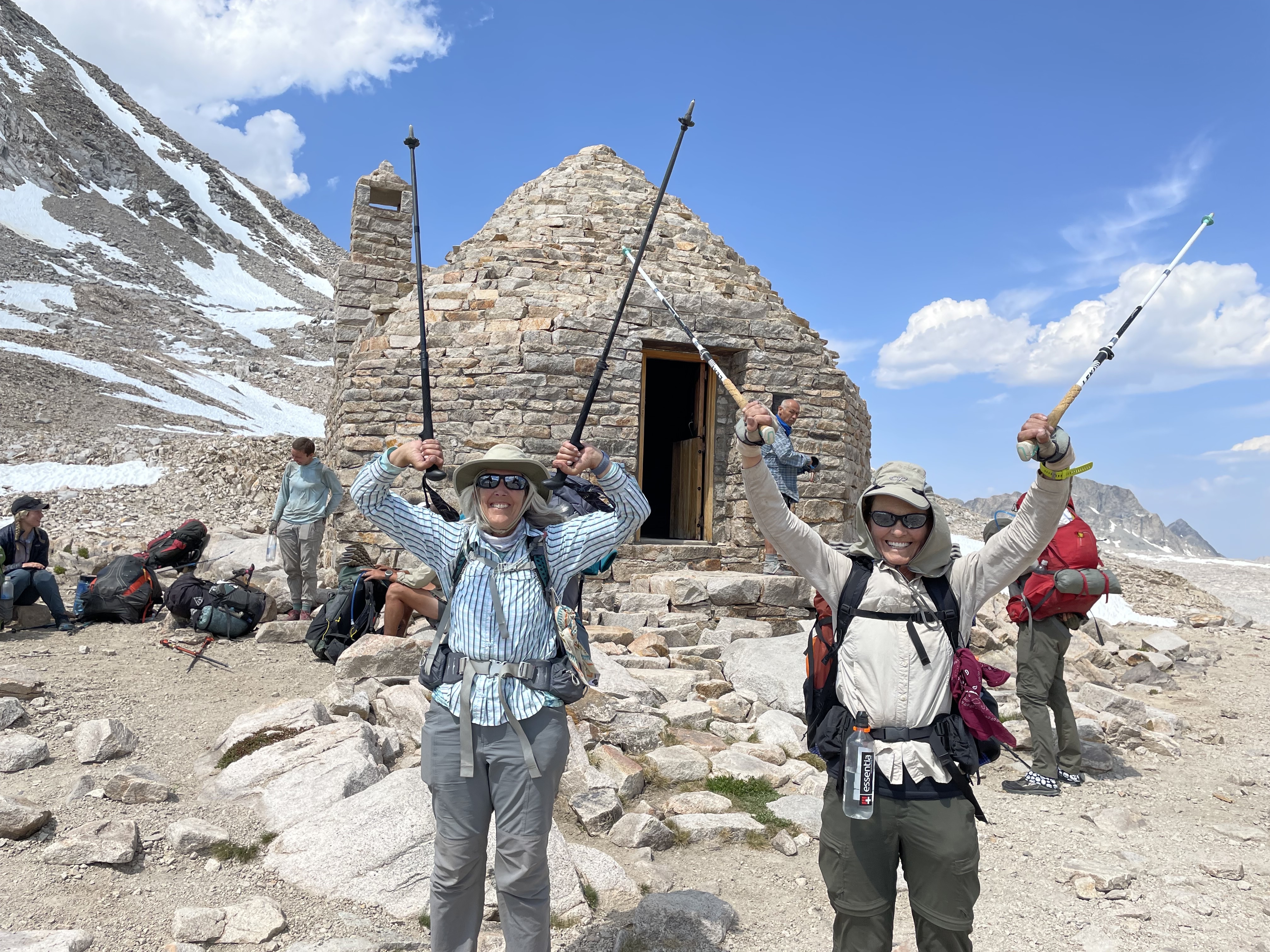
And it seemed in no time we reached Muir Hut. Following the obligatory poses and pictures we were ready to climb down. Looking down the hill, we faced the truth. There were many patches of tricky terrain ahead. Ankle breaking rocks large and small served as detours around unstable snow patches obscuring the trail. Robin does not like downhill, and damn if she didn’t fall. We both were feeling low. Our diets were lacking. So, we stopped and set up the stove right on the trail. We chose to make the only freeze-dried breakfast we had. It tasted like the packaging. We it to our garbage at the bottom of my bear canister.
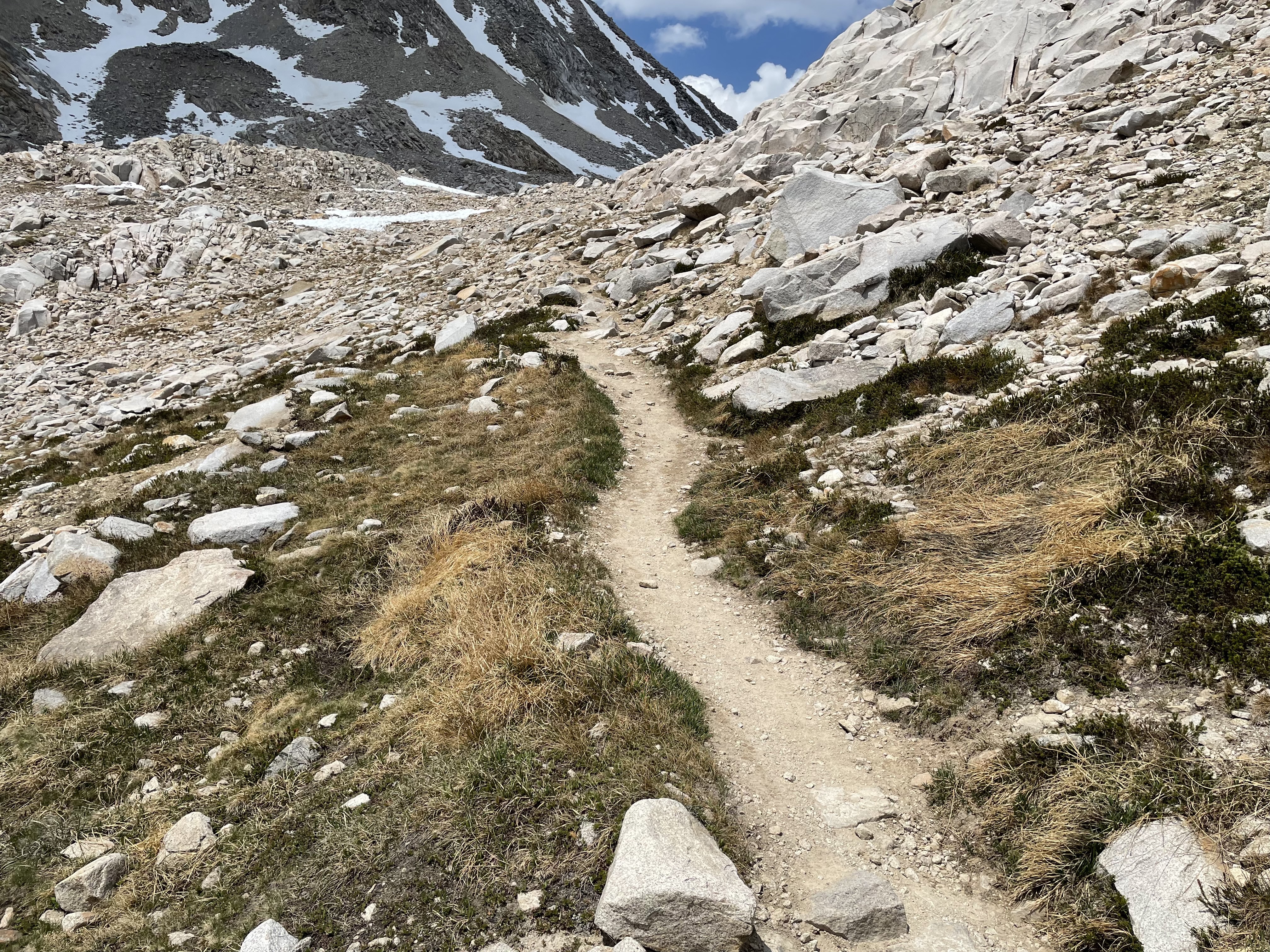
A Clear trail for awhile
A young male hiker stopped to talk to us. He had a hiker’s guitar and looked friendly and one with the trail. However, his girlfriend had gone ahead because he was suffering from intestinal destress brought on by his trail food. Also, he had just lost his job as a music teacher. It was an opportunity to develop his next career: freeze dried hummus. It was all about the marketing. This was hiker humus. Look for it soon.
Back on the trail we faced a snow slide straight down executed by glissading. We faced so many features with roiling, fast water lapping close to our safety. Then it seemed in a mere in a few steps we were surrounded by a bucolic forest.
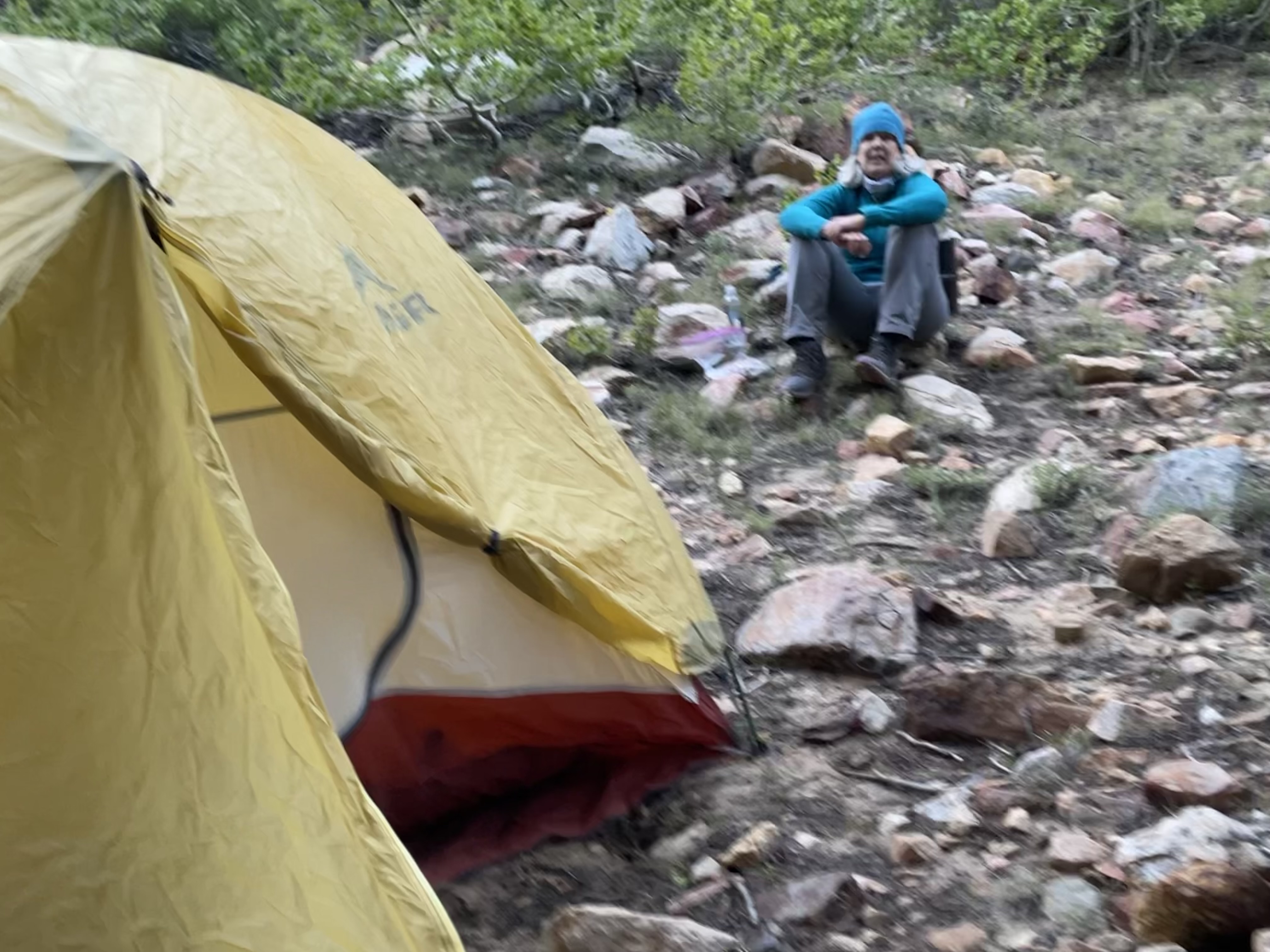
The clouds started billowing up and tinging dark. We checked our raingear and concluded it was paltry. If we proceeded, we’d get soaked. It started spitting just as we came upon a camp with many possible sites. It was empty and Robin picked the perfect site under some tree branches. In short time, we were joined by six or seven or ten, who knows, PCT hikers. The rain seemed quelled.Our tent neighbor had joined his daughter for a two-week stint on her PCT journey. When I found out he was a Trust Attorney, I asked if I could ask him some questions. He pulled up a rock and said he’d give me a consultation. Then, to make sure I’d remember his words, he made a transcript on my phone. Trail magic at the end of the day.
We woke in good moods due to sleeping on soft, level terrain, and having water close to us. Plus, even at water’s edge the mosquitoes weren’t bad. Perhaps, our perfectly safe poison, Permethrin, that we sprayed on our clothing, did, in fact, keep mosquitoes at bay.
We greeted some PCT hikers passing by our camp at hardy paces. Each one had a bright smile, a golden tan, and killer legs. We became salmon swimming upstream. Surely this direction only created an illusion that we were that slow. We chatted with the friendliest, mostly about my Garmin inReach Explorer Plus. The dang thing hadn’t worked yet. I scanned the northbound hikers to see who was wearing this product. Unfortunately, they all claimed they didn’t know much about them, yet they poked around with my unit and declared that it was at least on. I had this notion that Terry would worry if he didn’t get a signal from my device. What I found at the end of the hike was even though he hadn’t received any signals, he didn’t worry or care. He had total confidence in us.
I could chock this up to one of the things I worried about unnecessarily. Both Robin and I were eager to check off dangers that lurked. Such as Evolution Creek. This can soak you and everything in your pack, so people were giving us advice as we approached it. You can enter somewhere else. You can remove your shoes. You can hoist your pack over your head.
It is a wide creek and you do need to wade through the spring run-off. And that’s just what we did, easily. Shoes on. Comfortable temperatures. Not slippery. Ankle deep. No worries. Other then we were in a drought.
A 67-year-old MN guy, put us on to free food at the McClure Meadow Ranger Station. I mention the guy’s age because he was proud of doing so well at this age. I was proud that he was from MN.
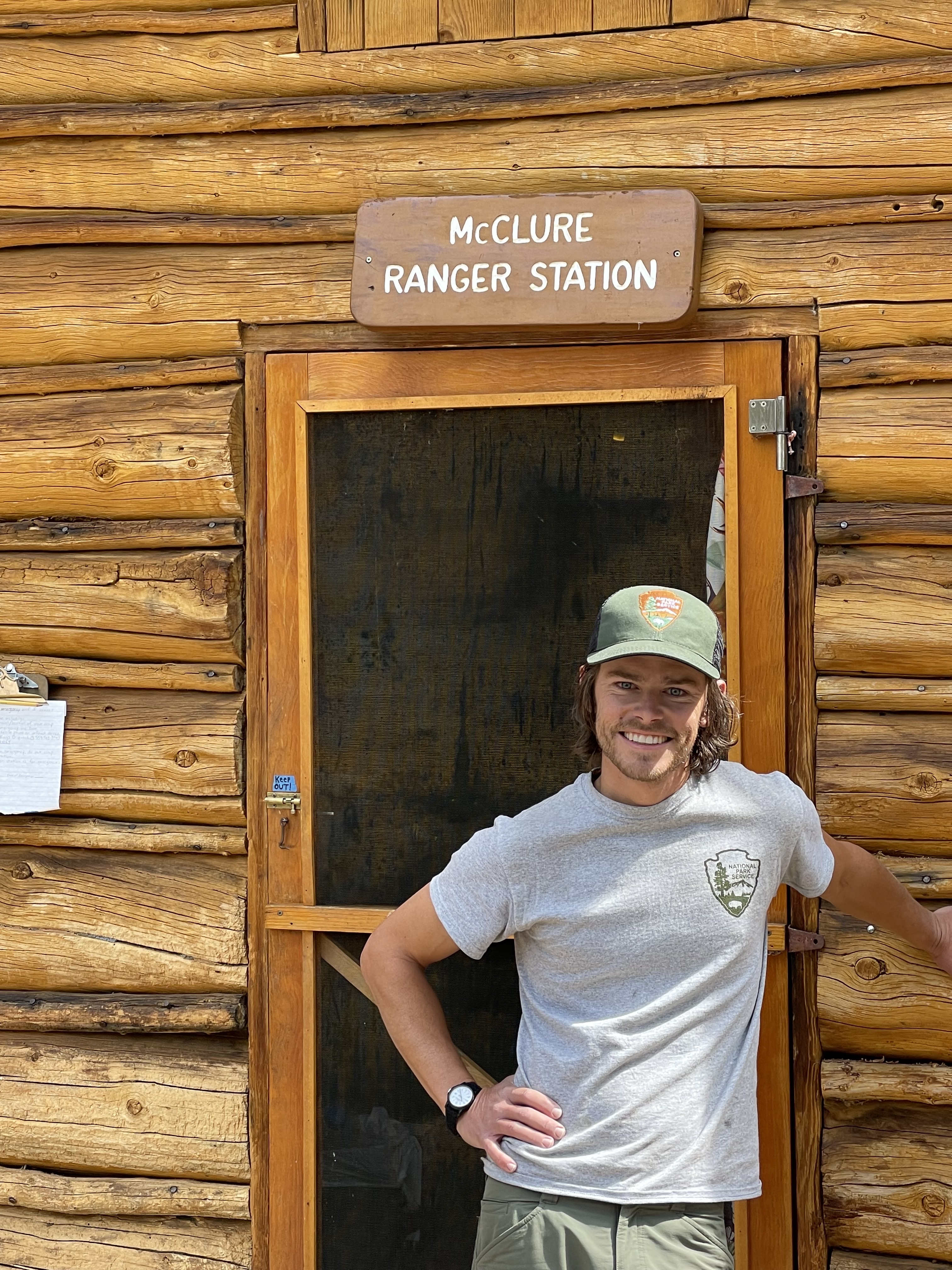
We watched for the McClure Meadow Ranger Station sign. Basically, it was right on the trail, but I walked past it. “It’s right here” Robin said. As we could have guessed, PCT hikers were foraging through the box while encircling it. Who was getting what? What were the choices? It was hard not to feel guilty taking anything away from this group. Robin got a tin of oysters and asked Ranger Victor, a new pal of ours, if he had TP. He gave her a roll. Perfect. Perhaps the oysters might prompt the need for more TP. It turned out of all our food choices we both liked the little bag of olives, and Robin liked the oysters too.
There was a group of six men assembled behind the food box asking about the choice of food but remaining shy about checking for themselves. They were a disparate group. One guy was in his thirties, and one was fifty, the others were approaching my age. Two presented as over-weight broken down guys. They appeared to be unlikely hikers. They left shortly before we did. About 1/8 of a mile later, we ran into them sitting on the side of the trail. We stopped to visit. Pete, the oldest with a brace on his knee, told us they were hiking to a carefully guarded secret destination. It was the deepest canyon in the US. He said they had planned this trip 25 years ago. And finally, they had time to do it. This meant traveling on a mostly cross-country route to Tehipite Dome and down deep into King’s Canyon. Pete was good at piquing my interest. I couldn’t wait to learn more. According to my feeble research on the internet from Spanish Peak to the confluence of the middle and south fork of the Kings River the distance of 8200 feet made it the deepest canyon.
We headed off to the switchbacks before Evolution Lake. We stopped for a rest and the guys passed us slowly except for Pete. He came later. He looked slow but steady and robust. As we move forward, we’d catch the guys who had gone ahead to wait for Pete. They always said, “He’ll catch up.” But we never saw him again and after Evolution Lake, we left them all behind.
At a creekside, we met one of the most flamboyant characters, Vince Connolly, or “Sugar Bon, Bon”. He was a ragging liberal. He said Michelle Obama had it wrong. It’s not, “when they go low, we go high”. It’s, “when they go low, we put our knee on their necks”. He had every anecdote, saying, and slogan modified, polished, and memorized to incite. He was nonstop anti-Trump. It was 15 minutes of major Trump bashing.
Good thing we were on our way to some to the most peaceful and beautiful tarns on the trail. We were headed for Wanda Lake but mistook the small lake in front as a corner of Wanda Lake. It all worked out fine
I woke at 3:00 am to the sound of a mountain quail. The night had been rife with screaming wind gusts. Now it felt calm and mild. Perhaps it was as warm as the low fifties. I lay until I fell back to sleep. As far as I knew when I woke at 5:19, Robin hadn’t moved all night. I imagined our rock platform and the long view down our ledge had been there for centuries mostly in this same state of repose. This peace was ours.
We had just enough water for breakfast, which is as it should be. Don’t carry unnecessary weight. Despite things seeming as they should be, we didn’t know what we were headed toward.
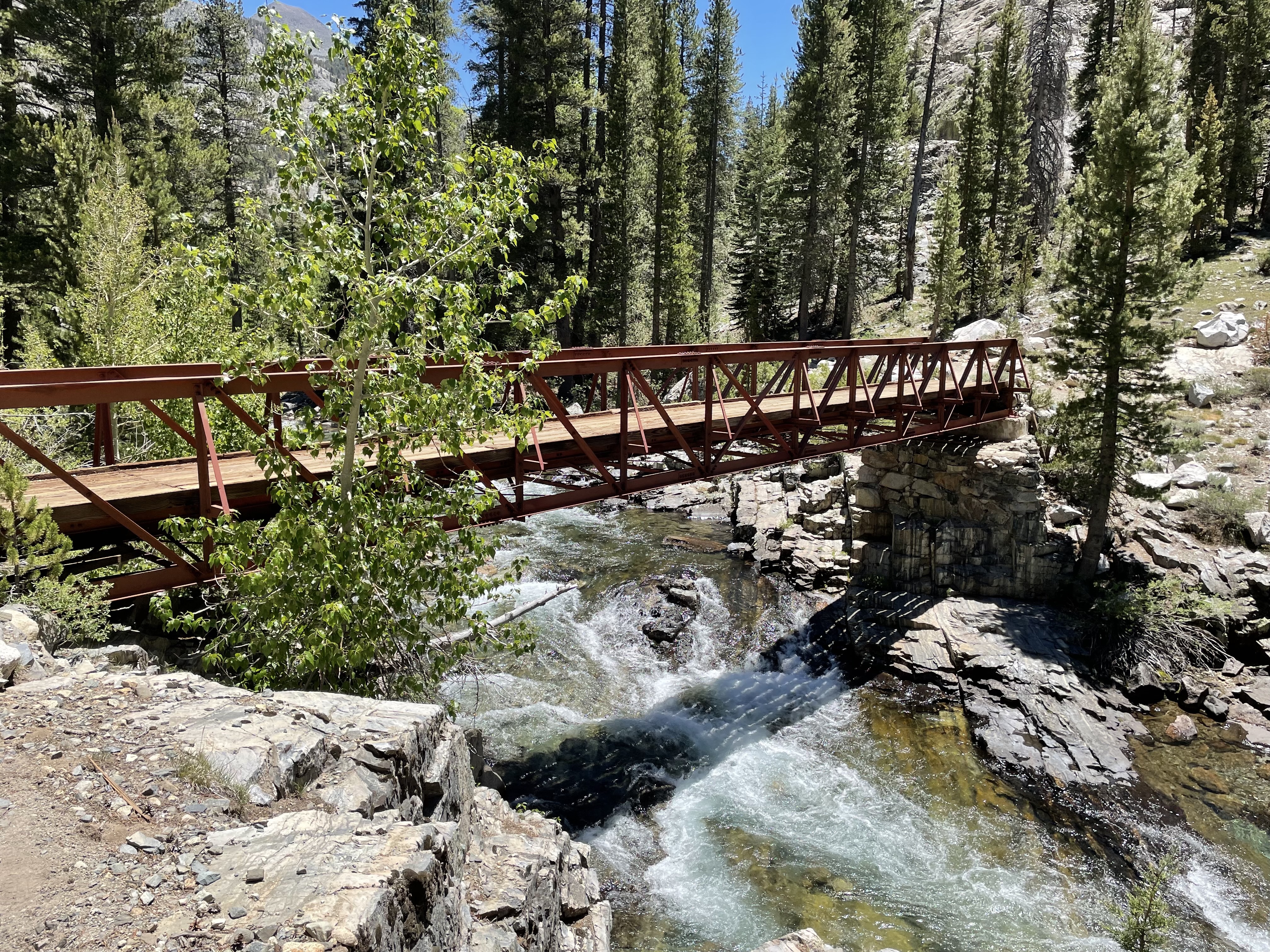
The looming of crossing that roaring creek, a river really, was a haunting menace. We knew we must get on the other side. We hiked higher over rocks, big ones, often rolling them unexpectedly. We were almost exhausted of water. All this uncertainty plagued us. Until I turned a corner and there it was: A Bridge. The most exquisite bridge. Cheers. Our trail ended and we walked over raging waters on our first bridge on the John Muir Trail, JMT. Accessible water awaited us. The terrain seemed almost flat. And real camps with totally flat tent sites were along the waterside. We chose a beautiful four site camp to ourselves.
After nine hours of sleep, I was surprised. How did I sleep so long? I lay until 5:00 am assessing my condition. What should I expect out of this day? Can we make it at our current pace? We don’t know the exact mileage for this hike. We had seen both 53 miles, and 59 miles listed for this trek. It would turn out to be 61 miles for us. Naturally, estimation will play a part in our daily expectations. Prior to our start, we had batted around the idea of twelve miles per day. That would get us there in five days. That seemed a bit out of our range. We were predicting 6 or 7 days. Seven days would put us at an 8.7 mile per day pace, and six would put us at a 10 mile per day pace. Our permit was good until June 21st. If we used all that time, we would run out of food. So, I felt a need to evaluate our pace. I figured we’d get faster as we went along, however my uphill speed was slow and I figured with Muir and Bishop passes ahead, they would slow me.
Robin woke with dry heaves. She didn’t believe she was suffering from any effects from altitude, rather she believed the eggs at Starbucks were bad. Or perhaps it was the restaurant food. I agreed that the food was suspect. But whatever it was, she would need to eat for energy.
We were in Humphreys Basin starting on an easy downhill without too many rocks or obstructions. We stopped for water and took breaks. I’m sure I was nagging about our daily mileage, when Robin became upset that I felt we needed to finish in six or seven days. I thought it over. I didn’t want to feel I was pressuring her. Nor did I want to pressure myself. So, I told her that we have ten days on the permit and if we go ten days, we go ten days. I’d try not to mention this again. We talked about conserving food. The portions were large, so we could try to share them. She still had no appetite. I think she would have given me her whole meal, but she was satisfied giving me more than my share.
Our trail started to ascend. We were leaving the water far below. The trail turned rocky, and the pine trees reappeared. We entered Piute Canyon. We remained unsure where the next water source would be. We were also unsure about how the reported “Pine Creek Pass” would impact us. We weren’t going over it, but would we have some switchbacks? Also, we needed to be on the other side of the creek, which was huge and roaring.
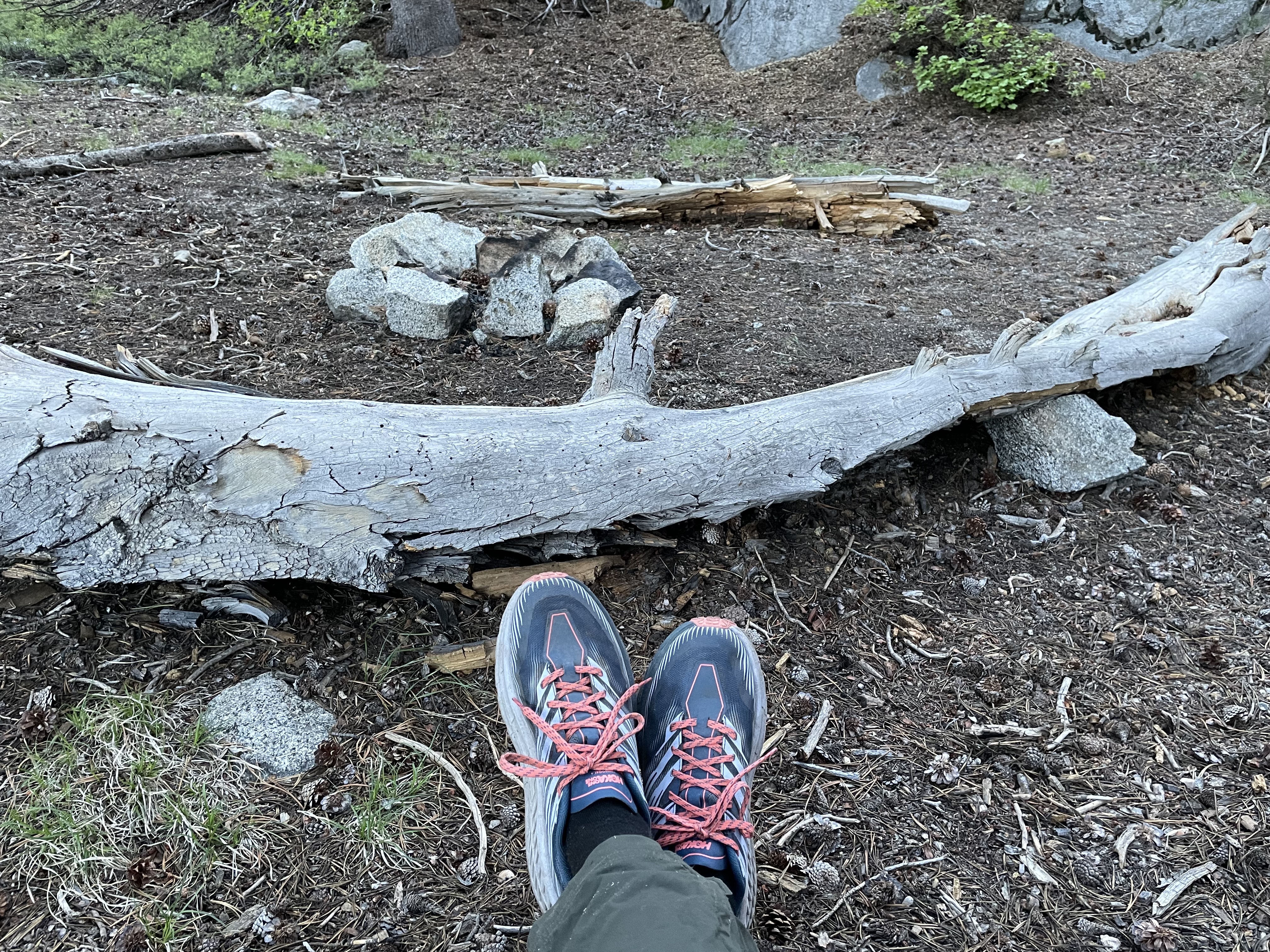
So far, we hadn’t seen anything that looked like a tent site. But there it was. On our left with the creek roaring below, was a tent site. On the other side of the trail was a rock fire ring. Of course, you can’t have a fire, and the wind was so strong, no one would even consider it. We did sit on luxurious logs in front of the ring to eat dinner. And surprise a couple appeared. We had considered the possibility that the Zombie Apocalypse had left only us. We were relieved. They said they were with three others who were behind them. The three, Danny, Katie, and Karin, really didn’t seem to be with them. We guess the first two were the zombies. We leap-frogged with the threesome until our last day.
About an hour later, as we were brushing our teeth, a young man came from the opposite direction. He needed water. He left North Lake days ago heading on a short trail to the left of the Piute Trail. He continued cross country to Goethe Glacier and Darwin Canyon. It was the hardest thing he had ever done. He seemed desperate, feral, half-crazed. We had no water to give him. We were pretty sure he wasn’t more than two miles to water.
Hikers were walking past our tent as we scraped ourselves out of the bramble and stumble onto the trail. We had unwound from our bags and tent to head up toward Piute Pass. It proved beautiful. The aroma of lodgepole pines and the graceful movement of quaking aspen prompt us to stop and inhale the moment. At the foot of the Piute Crags, the trail followed the creek. The top half of the ascending trail left most of the trees behind and the glacier carved granite benches and the many lakes dominated. We passed Loch Leven and Piute Lake.
It proved terribly grueling. Robin’s steady pace often took her out of my sight. My push forward would stop me breathless. I recalled the symptoms of altitude sickness and now we both hadheadaches and upset stomachs. As the day progressed our symptoms remained nagging but not alarming. Afterall we were maximizing our exertion level.
The steady increase of hikers began to feel like hoards. Robert and Steve met us as they headed down from the summit without packs, left behind for an easier jaunt to the top. Afterall this is their territory and thus providing them high altitude lungs. Two women of our age were pretty much skipping up the “hill.” They greeted the guys. Granted, they too were unencumbered by packs, which seemed to make it just a walk in the park. They advised Robin to veer left and skirt around the snow to reach the summit. And without much more ado, there we were at the top. Just like magic we stepped down the lip of the pinnacle and left all, absolutely all, of the hikers behind. Along with all the people, our clearly delineated trail was gone too.
Thank God, Paul, Robin’s husband, had loaded the Gaia app on her phone. And even though he failed to give her any training, she patiently poked around on the app until she felt fairly confident she could lead us in the right direction. This wasdefinitely the road less traveled by, so that app made all the difference. This piddly trail did not resemble the highway of a trail on the east side of the pass, so she had to do plenty of deciphering. She was spot on. The entire view that lay before us was wide open granite boulders and benches only lightlypeppered with stands of brush. Luckily, rivers and lakes were plentiful.
We were so alone, we wouldn’t see another soul during the next 24 hours.
We erected our tent on a rock slab at 3:00 PM. We found a clump of bushes to hunker under for shade to read, write, and decompressing. Our first freeze-dried dinners were hard to stomach. Robin was really feeling badly. Still at 10,000 feet, I fell asleep before 7:00 PM with a headache.
At 7:30 AM, I loaded my backpack, my walking poles, and other equipment into Robin’s car. At her front door Bear, her dog, barks, and the cat tries to squeeze out. Closing behind the commotion of leaving, we take off for Bishop, CA. Six miles into our 316-mile journey, we stop at Starbucks for coffee and eggs. The eggs tasted suspiciously weird leaving Robin’s stomach unsettled.
With little traffic, the drive was easy. Highway 108 was scenic, windy and forested and took us down to Highway 395. We stopped for lunch just before the turnoff to Yosemite. Down to Bishop, Siri led us to Robert’s house. His friend was going to join him for an overnight up Piute Pass. This was comforting to us because Robert was going out of his way to shuttle us. It’s nice that he had another purpose,
We followed the guys for thirty minutes to South Lake. We packed our gear in their trunk and left Robin’s car in the parking lot waiting for our trail exit into said parking lot in eight days’ time. We continued the drive for twenty minutes to North Lake. The confusion of the hastily leaving of belongings and comforts behind unnerved us. We were exiting someone else’s car in a rushed manor. They were off and away as we were still checking our gear and using the outhouse one more time. What had we left behind? Under our too-heavy packs, we struggle for each breath.
During our drive, the guys consulted us about our experience with altitude. As they ticked through symptoms, Robin told them she had climbed Kilimanjaro. I silently recalled how I suffered last year climbing Donahue Pass which is almost 1,000 feet shorter than Piute Pass. As they listed symptoms, I seemed to have each one.
There wasn’t much time to dwell because it was later than we planned to leave. My hope in leaving in the afternoon was to lop off a couple to miles before we officially started and to sleep at an elevation gain that took us from 4,150 feet in Bishop to almost 10,000 feet on the trail. After dragging ourselves and packs 1.5 miles, we wanted to just breathe. We ducked behind some trees in poor terrain to pitch a tent.
Hope our other sites will be better.
It was rocky and slanted which caused silent tension between the two of us. Robin had never bought into my idea of leaving early, and now we’re suffering the wrath of a bad campsite. She had implored me to stay in town. I hoped this small jump on our permit would be a big boost to our endurance. I couldn’t take back that decision now.
My friend Robin and I are going up Piute Pass tomorrow. The pass is pictured above. On a training hike, Monday at Nisene Marks State Park, we talked with a bike rider and discovered he was from Bishop. That’s where we’re heading to hike. It’s 190 miles away from Nisene, and there he was. We asked about shuttle buses between the trail’s end and the trailhead a distance of seven miles. He volunteered to drive us if we bought his daughter’s first book which was published just before the pandemic.
Now we plan to see him tomorrow at his house. He’ll follow our car with his to the trail’s end where we’ll leave our car. Then, he’ll drive us to the trailhead. Our car will be waiting for us at the end of our journey. How sweet is that? His daughter’s audiobook is on my phone to be be read to us while we drive.
We arrived home last night. It’s time for me to reconnect to my life here in California.
Here’s the scene: Traveling at some kind of warp speed over highway 17 in the Santa Cruz Mountains, like being shot from a canon and landing in the front seat of a 2008 Subaru Outback in the passenger seat asking the driver, my husband, “Why are you driving with your sunglasses on when it’s dark out?” Well it’s jarring, dislocating.
Before I snapped my fingers, I was walking on the Kuskokwim River on the Ididarod Trail.
Today Terry viewed his day from an invisible perch. Above the real scene below.
When we ascended from Seattle, the hues below were bright yellow, and green. They were so brilliant. The yellows were the yellow lines painted on the roads. All the vegetation was green. It’s funny what you see after two months of black and white and shades in between. To go from moving at pedestrian speed to jetting. From the silence of standing in a boreal forest packed in insular snow where not even a pin makes sound waves. From that to the clamber of a city airport . . .
Well, it’s over. I will bask in the afterglow of McGrath in fourteen days when my test is negative. I thought I was beating the chances of Covid by traveling on an airline with strict distance rules to a village with no cases. But now we’re facing no rules on the plane except masks. Santa Cruz is now orange.
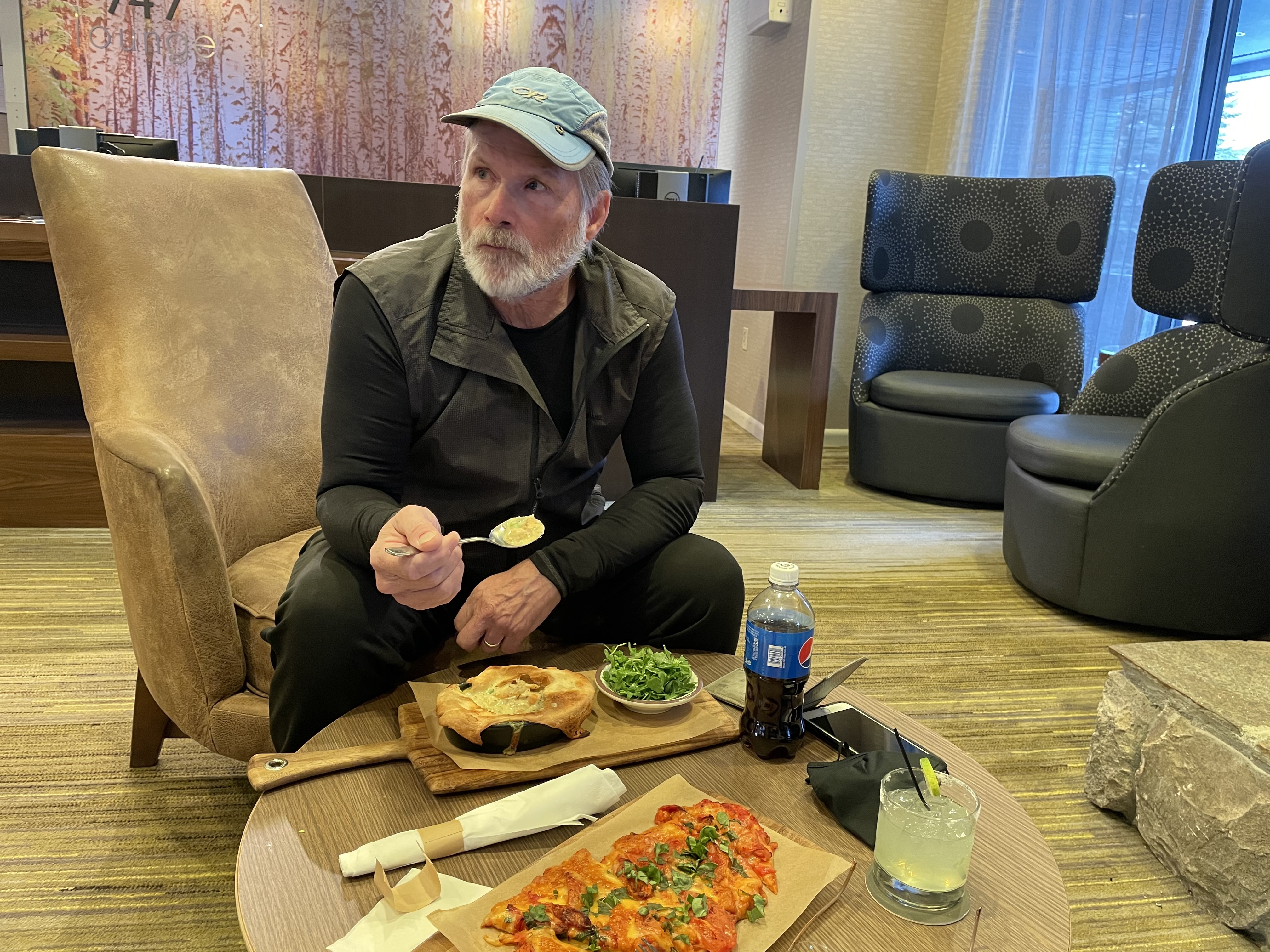
Here we are at the Marriott Courtyard in Anchorage. Dinner with a adult drink.
Our send off at McGrath Airport was sweet.
Elsie came down on her snow machine to see us off.
All of our peeps are the walkers in town. Elsie is 73 and the doctor told her to exercise so she walks about four hours a day.
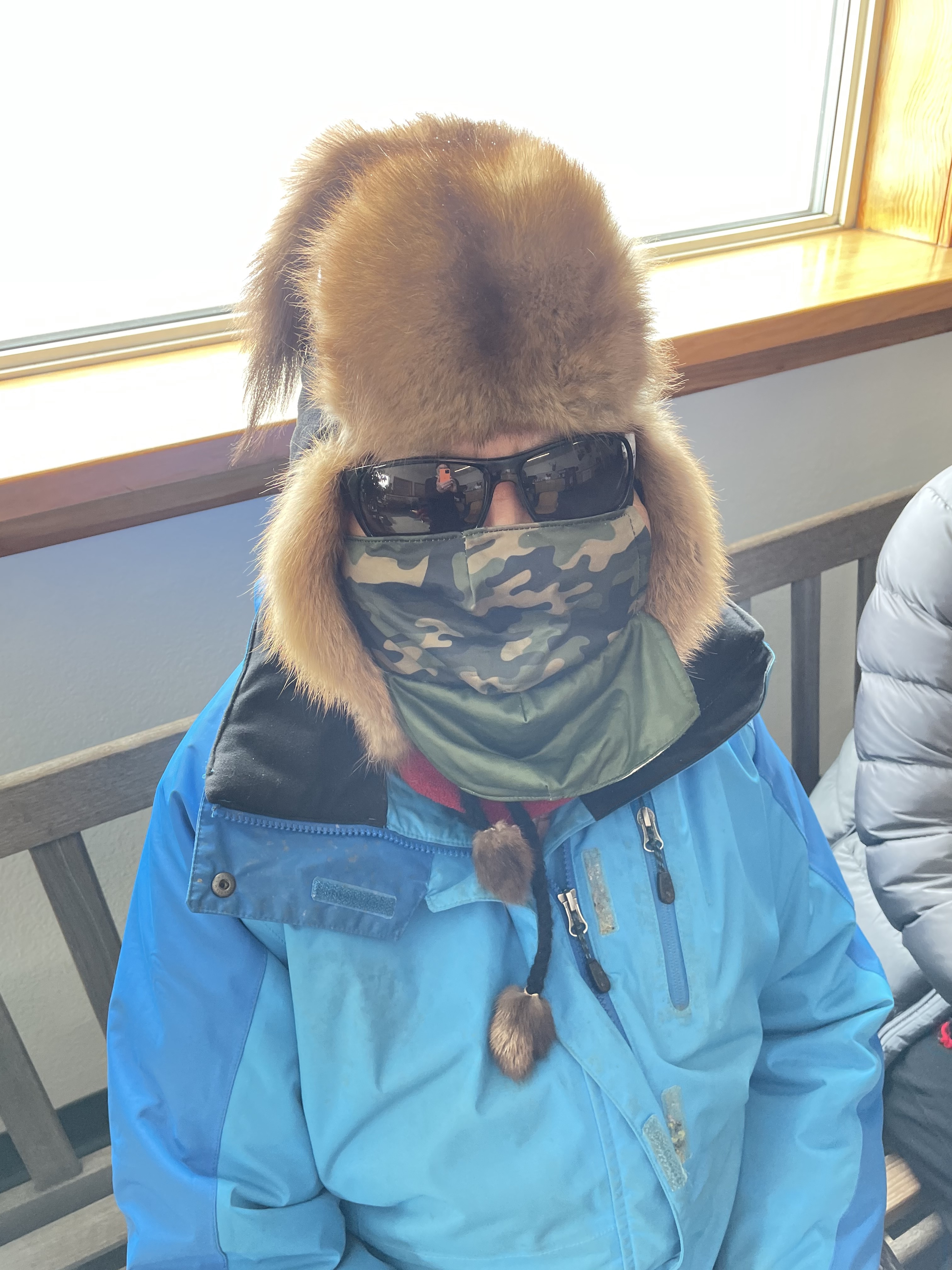
She asked Terry where his mask was. He said no one is wearing one, so I took it down. We’re not even close to each other. She said the sign on the door says you must wear a mask. He put it back on.
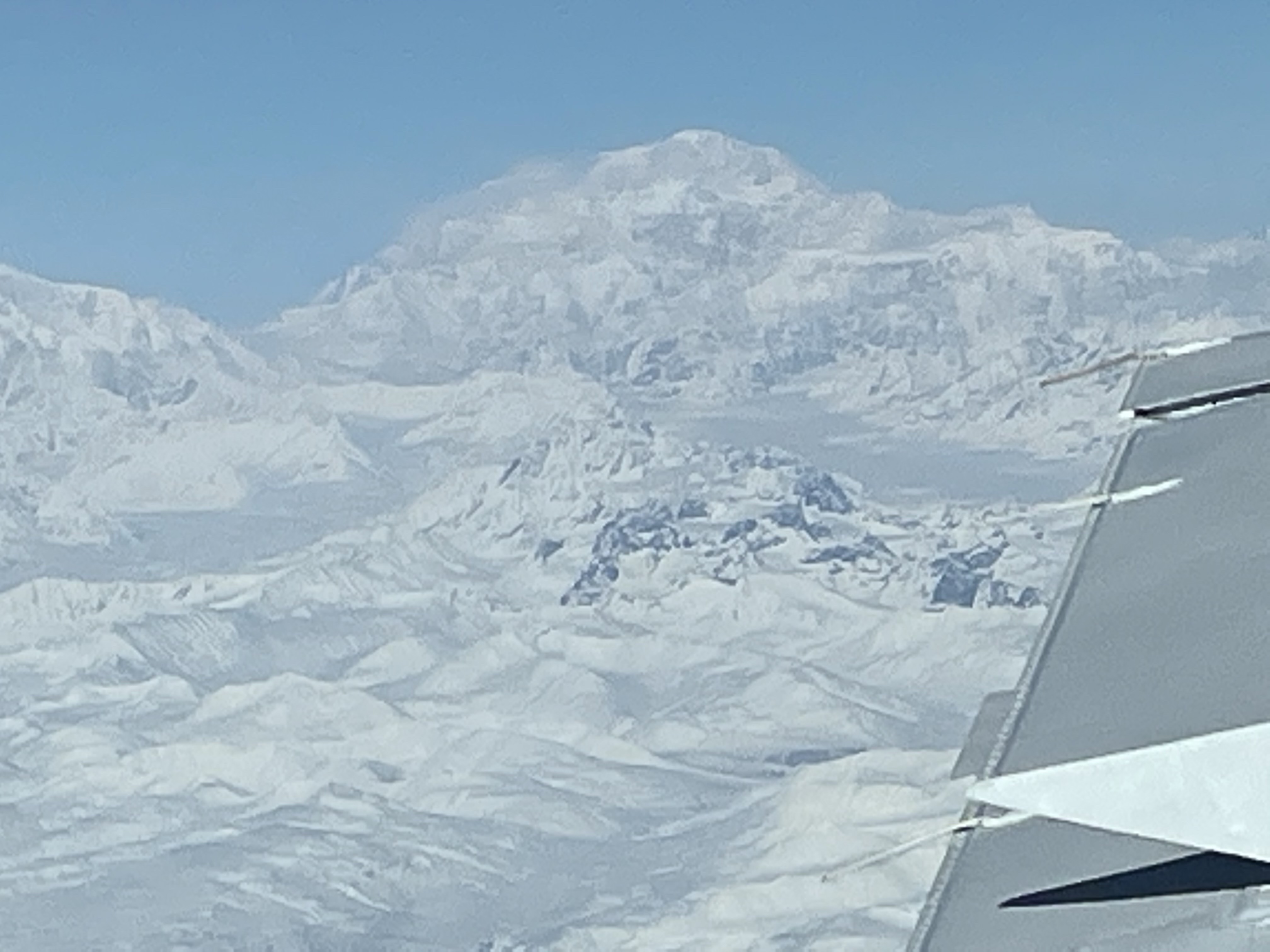
Finally our Denali view as we fly just south of it at 19,000 feet
In Anchorage, the little waiting room at Reeve air was beautiful and they had bags of famous Amos cookies. The two pilots were fun, but it all ended when the hotel called and said their shuttle driver was circling the airport trying to find Reeve Air. I ran out to wave him down.
This is from our journal written 20 years ago when I taught in Graying AK.
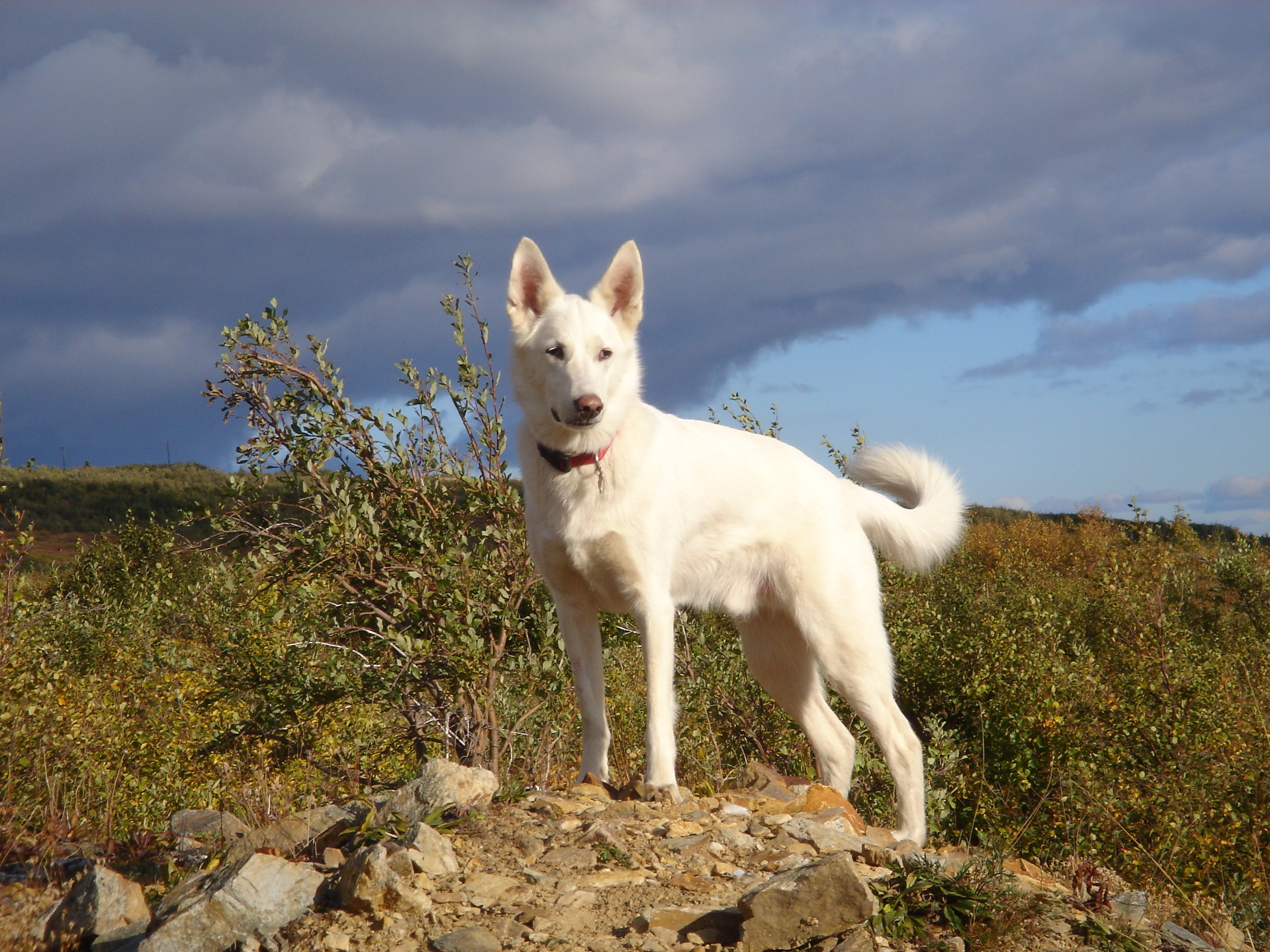
This was our beloved dog, Mukluk, in 2006 outside of Fairbanks
Muk’s Big Adventure #4
Friday, eight AM, we stand in the storage room behind the Anvik gym buttoning, zipping and Velcroing our clothes. I took care not to leave any of my skin exposed. My mask was tucked under my goggles, gloves cinched inside jacket sleeves, mukluks laced high. Our narrow plastic sled carried a Rubber Maid tub and two plastic delivery bags full of gear. Terry attached the dog’s stretchy blue leash to his gun belt and snapped it to the sled, with its 85-pound load. I wore a light backpack stuffed with the day’s essentials. Also on the sled were a pair of skis—for emergency use—and both pair of snowshoes. The trail was hard packed. There was no need for snowshoes this morning.
We had over-nighted on the gym floor, on a pile of wrestling mats. This is our favorite bed and breakfast. We love raiding the four freezers and having all of the cafeteria to ourselves. Muk loves licking syrup and ketchup from the floor. The gym mats, balls, baskets are ours to play with. We can lounge in the library reading and checking email. Muk had played for hours with one of the daughters of a teacher. She told him she has gold, and Muk is the gold-robber trying to get it. He didn’t mind being bossed around; it was a fun game for him, too.
The staff would start arriving by 8:00 this morning, so we needed to hit the trail. The school thermometer registered –22 degrees as we started a brisk pace down the hill to Anvik Creek. Out on the ice the coldest air had pooled, and it was colder. We didn’t talk about it. Our masks were layered in ice around nose, mouth and eyes. Muk dropped to the ground often to bite at the pads of his feet.
Anvik Creek makes a wide curve around an island that kept us in the shadows. We were both digging hard with our poles, trekking, trekking, as fast as we could. Normally, the puppy in Muk would have encouraged him to chase the occasional blowing leaf, or dig for partially exposed, left-behind Iditarod booties, but he, too, was moving fast, pacing up ahead then back. For an hour and a half we pushed hard. Just a short stop and eyelashes need to be pealed apart. In order to do this, gloves had to come off. My goggles were frosted inside and out. Through this lace of frost, Iditarod markers were barely visible. Freezing is painful; movement mitigates the pain. Even though every step kept us warm, it also pushed our distance past the point of likely retreat to Anvik. I don’t think you worry about freezing to death until you are really desperate, but I worried about frostbite.
At the confluence of creek and river, we curved directly into the sunshine. The absolutely clear air and total whiteness result in unimaginable brightness. It was warmer, maybe only a couple of degrees, but each step into the sunshine seemed better. My breath warmed the frost from my goggles. Thankfully, there was no wind. I looked back at Terry. He was totally covered in fine-frost fur from perspiration wicking to the surface and freezing. Long icicles traced his beard and mustache. His long white eyelashes look Vegas showgirl-like. “It seems warm now,” he yells. “I’ve had to chip the ice off my eyelashes a couple of times.”
By now, there was no way I could wait any longer; I had to urinate. Women have to expose so much of their body to do this. And so many simple things sap warmth. Just holding the metal part of ski poles instead of the handles—with gloved hands no less—can steal enough heat to force you to put the poles under your arms and pull your fingers into a ball. This little inconvenience will slow your pace and next you’ll feel the heat leaving your thighs. Not only does pulling down your pants and hanging your steamy derrière out into the minus-minus air assault the immediate area, but also it pulls heat from your core. This fact is a constant reminder that you cannot easily escape the cold by going into a car, a building, a store, a house, a garage. No, this is spending hours with minimal chance of rescue, and it’s on our minds, at some level, the whole way. I picked up the pace to compensate for my brief exposure. We were making good time, and my body temperature hadn’t suffered. By late-morning, we could both relax. The sun definitely warmed us and only the shadow side of Terry was still frosty. When Muk lay down, we cupped his feet to warm them. Earlier, neither of us could have stopped. Muk got up prancing. He, too, was happy with the way the day was turning out.
Up ahead I could make out an animal running. Binoculars helped identify a single, large wolf heading into an island of willow thickets. Our trail followed a channel between island and shore. Willows rimmed this island, and it was where we had seen moose two days earlier. They survive the winter primarily by munching willow stems and buds. If you break open their pellets, sawdust spills out. On the opposite side, a pair of wolves hunted the shoreline. One stopped when it sighted us and charged our direction. When it became clear to him that we were not prey, but predator, they quickly disappeared into the woods. The trail was covered with wolf tracks. We decided we were dancing with wolves. The temperature finally seemed above zero, but removing your mask quickly dispelled that notion. Still, it was a perfect day. We were both hoping to see more moose. In the distance was another movement, approaching rapidly At that pace we knew it was a snowmachine. An animal was draped over the rear. Richard turned off the engine and said he thought we were broken down snowmachiners. The wolf, shot ten minutes earlier, was the first one that we flushed out. He had run it down as it tried to cross the wide expanse of Yukon ice. It was hog-tied on his luggage carrier. Blood spray covered the rear of his machine. The animal’s tongue hung frozen stiff, eyes still open. Muk didn’t growl or act surprised. He looked it over and decided the break was an opportunity to lay down and rest. The feet on a wolf are huge. I doubt few dogs have such big feet. There’s a one hundred-dollar, native only, bounty on wolves, plus the untanned hide is worth another $250. Wolves have really depleted the moose population, along with illegal hunting. I had just been considering how sad it is that moose are so large and it’s so hard for them to hide. Just when they bed down, the wolves come in and rip them apart.
In the novel Winterdance, by Gary Paulsen, he talks about how brutal it is to witness wolves killing deer. I don’t want to see it, nor do I want to see an Native Alaskan running down a wolf on his snow machine. But out here it doesn’t bother me seeing the dead wolves, the way at home it bothers me seeing cows or chickens being transported to the slaughterhouse. Something, to me, about the scheme, seems more sporting, more natural.
Much of the river appears as frozen swells undulating toward shore. A feeling of walking on water progresses to the feeling of being on a boat dipping up and down on the waves. At times, we were between troughs. Sometimes the ice peaked up into winter sculptures. Way below-zero snow cracks hollowly under your feet—it’s not the crunch of cold-weather snow or the pad of warming snow. The Athabaskans have sixteen words for the different types of snow. We surely have seen it transform today. The distance is marked by high cliffs rising from the Yukon’s western shore. To the east is flatland. While in Anvik last summer, one of the Natives had told me the names of the peaks—four mile, eight mile, twelve mile. Near the high cliffs, the shore ice is devoid of snow. It’s glacier blue. The cliff’s snow is glazed and shiny. Somewhere around here is the open hole, which has claimed the lives of many people over the years. It is hidden by deep packed snow now, but still dangerous. We trust the trail gives this area sufficient detour.
As we walk, these cliff markers approach slowly. It reminds me of sailing and wondering what it will look like around the bend. As we get nearer to Grayling than Anvik, white capped hills rise dramatically in the distance. The north wind begins and increases as we head upriver. I slow because of a tightening Achilles. Walking in Mukluks takes its toll after fifteen miles. With no heal or real shoe box to grip my foot, it’s almost like being barefoot. The slight movement of my ankle against wool socks has caused a rash that now flares. For a couple of miles, Muk has been bored and tired. Because I’m in the front, he has been trying to get me to stop. He walks between my poles and me. He looks up pleading. He leans against my leg. He walks up between my legs. He tries to trip me. I know how he feels.
About a mile from home, Terry says he’s going to push ahead to start a fire for us. We had set the diesel burning stove on 55 degrees. I’d like a warmer house. He powers ahead, and as the distance increases, Muk stops and looks at me then runs ahead and continues this until they disappear down the hill that leads to the village. I hear the village dogs going wild. When I get up to the village, I see a sad sight. Aimee and Mike acquired two puppies last fall. One was Muk’s brother, Reno. They gave him away a couple of months after they got him. Two dogs were too many for them. But McGregor, the goofy looking one, remained. He had become a long-legged, silky-coated animal with the ears of a donkey. He looks like no other in the village. They let him sleep on the couch and walked him around the village. But two weeks ago, anticipating their trip home this summer, they talked Fred into taking him. As I came up the hill to the village, the dogs in Fred’s yard, behaved as all the village dogs do. They jump to the maximum extent of their chains. They bark and yelp. They all look like village dogs—huskyish. Remember, they are staked so that they can never touch each other. Their only contact is when they are fed. Perhaps a good owner pats them, but mostly they are knocked on the head or kicked so that the feeding process is quick and unencumbered by dogs so starved for attention that they literally grab your leg with both arms and hold tight. There sat McGregor. He looked to the other dogs and occasionally barked or jumped, mimicking their behavior. His ears stood at attention while his eyes and movements betrayed his bewilderment. Where is the couch, the dog dish always filled, the warm confines?
I reached home about 3:30, shortly after Terry. He said, “You better go to school and take a shower.” Why would I go to school for a shower? It was warm inside compared to outside, but then I notice that I could see my breath. The stove had failed. It was 26 degrees. Water pipes were frozen, all the plants dead, even the olive oil had solidified. The only items to escape freezing were in the refrigerator. Muk immediately curled tight inside his kennel where he stayed without moving until morning. We lit a fire and walked to school. The hot shower I needed turned into a cool one. Nothing is ever fixed. Why there is no hot water in the shower is a mystery, but I’m sure it will not be fixed. Little things in my classroom that Terry had started to fix, but was told not to because he was taking away Fred’s job, have never been fixed. Only the bare essentials of everything work. By evening, the house warmed and pipes thawed. Unfortunately some were damaged. Water squirted from under the sink and shower extension pipe. It also dribbled from the toilet bowl gasket. Using duct tape, a clamp from his bicycle, and numerous tie wraps, Terry has temporarily repaired the breaks under the sink and in the shower. The toilet leak stopped when the gasket fully thawed. I know that Fred will never fix these problems. The next tenants will have constant drips. We’re sorry, but the store doesn’t stock the parts to fix these problems. Bush living.
That mostly describes the final day of our trek. Our original plan was to visit Anvik, then Shageluk, then triangle homeward, spending four days to cover the 83 miles. This overly ambitious plan was cut short by a very painful first day. I had not spent much time training and by mile 15, the snowshoe bindings had nearly crippled me, constantly squeezing my Achilles. Mukluks have no heel stiffener for protection. A limpy pace is a slow one, and I could no longer maintain body heat. Hand warmers were not enough to keep my hands from going icy. Terry and I swapped gloves several times so that I could benefit from his warm hands. With five miles to go, I was struggling with a falling core temperature. Feeling your spine growing cold is eerie. Terry was constantly urging me forward, “help yourself, pick up your pace, shake your hands, we’re almost there”. Unfortunately I was going as fast as possible, but the landmarks never came closer.
In my pack was a VHF radio and considered calling for help, but who would answer? And what would my class and peers think of me? Finally, Terry, sensing that I was really fading, came close, putting his arm around me, holding me tight, pushing me forward. The closeness added heat and security. As we walked in lockstep, my core stabilized, albeit below normal. Adding more handwarmers to my gloves failed to produce noticeable effects, but the buildings of Anvik were coming into view. It is almost a mile up the hill to Denise’s house. Due to my condition, Terry flagged down a snowmachiner who carried me to her door. She was expecting us, but was surprised at my icy touch. For several hours I snuggled on the couch wrapped in heavy blankets as heat from her blazing woodstove toasted me back to normalcy.
Denise is a cute, petite, 40-something woman. Carl, our special education teacher, has told me repeatedly how foxy he thinks she is. When we were in McGrath last week, he was prodding me to see if he stood a chance with her. She’s from MT. Her husband is at home. The plan was that she’d work here for two years until he took his sabbatical—he’s a teacher too. Then he’d join her with the idea of maybe moving. Her 22-year-old son is with her and may remain in Anvik. She has decided to leave at the end of her first year for many of the same reasons that I have outlined in earlier letters. I assured Carl that she was indeed married and not looking for anything else.
For a short time, Carl was a glassblower in Seattle. His personal mythology is that he’s a cultivated, eccentric artist, with joie de vivre—at times debonair, at other times Paul Bunyon-like. In truth he’s a likable fool. Sloppy, fat, whiny. He’s stuck in jr. high mode. When he feels insulted, he’ll say, “You guys wait. Just wait. I’ll lose weight and show you all.”
Near the end of our two-day inservice, Carl decided he had to make a move. He inched down the lunchroom table toward her. I was seated across from them and watched this tragicomic play of Carl’s. He put on his oh, so sensitive voice. He asked her about her troubles in Anvik. He told her how brave she was and how well she was handling things, and by the way, had he mentioned he was a glassblower in Seattle? Even though he loves the bush, he knows the finer things in life—coffee mostly.
When he returned to Grayling, he couldn’t stop himself from emailing her. He confessed his attraction. Carl always does stuff like this. At the McGrath meeting, in front of the entire school district staff, he would raise his hand and whine about this and that. The speaker would politely cut him off. Then for the rest of the meeting, Carl told everyone that he should have kept his mouth shut and that he’s always embarrassing himself and putting his foot in his mouth. Of course, everyone said, “It’s OK. You shouldn’t feel embarrassed. You were just speaking your mind like we all want to do.” In truth, everyone thinks he’s a goof ball.
Denise emailed a response that she’s happily married and she’s sorry that he couldn’t understand that. Both Terry and I picture Carl banging his head against the wall and repeating “Why me? Why me? Why do I always embarrass myself?” That’s Carl.