The last mushers have turned toward the finish in Deshka Landing, but there is still plenty going on in McGrath.
In spite of toe tingling temperatures, spring is bearing down. Ravens are pairing and gathering nesting material. They fly some crazy patterns and emit a wide range of sounds, around 280 different vocalizations ranging from a telephone ring to caw caw. There was a giant unkindness, term for a group of ravens, of them going crazy at the site of mushers’ straw. Discarded trail booties have become impossible to find, probably becoming part of raven’s nest also.
Poplars set buds last fall, those not munched by moose, are sneakily extending, hour by hour.
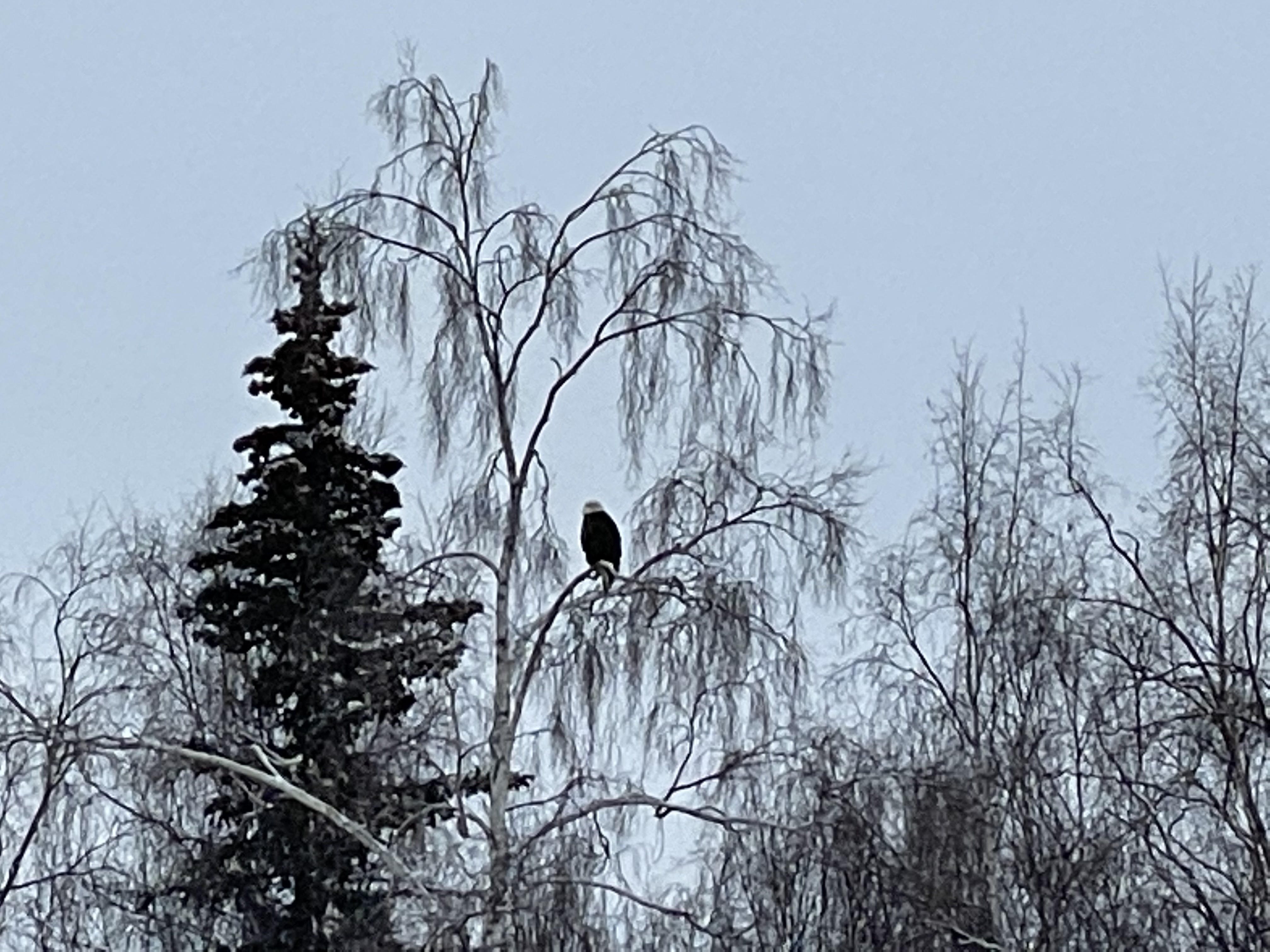
Earlier today, in the pre-dawn hours, Deb heard the haunting call of the northern hawk owl. It does not migrate, subsisting on squirrels and various rodents. Also we spotted an early bald eagle, motionless, saving energy, being swooped on by adventurous ravens.
The bald eagle is an uncommon sight this time of the year.
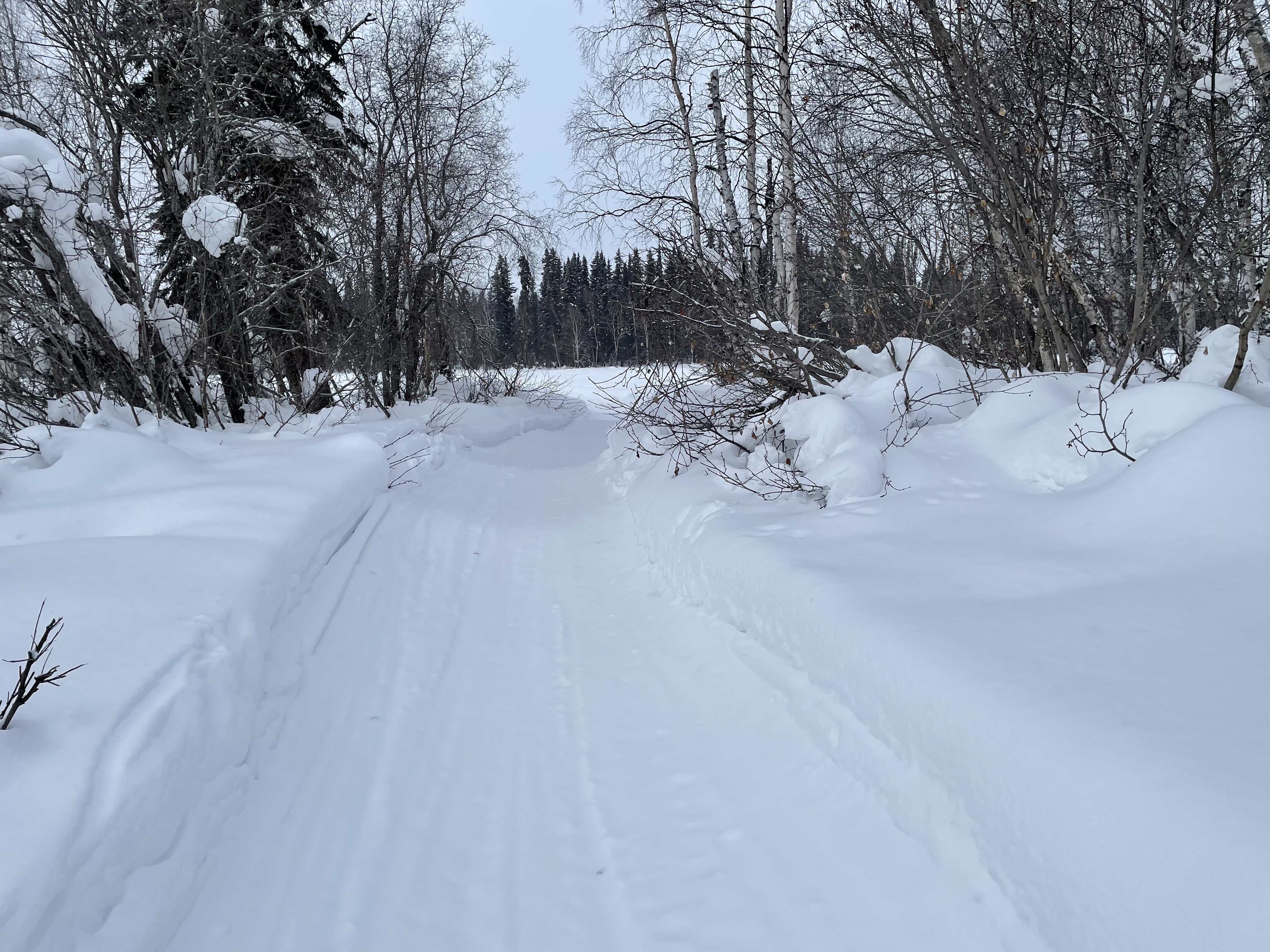
All mushers and teams were out of McGrath by mid day. We were free to pick around on the other side of the Mushers, encampment. We followed the trail for a ways up the Kuskokwim to the Takotna River. This wends it’s way through narrow land bridges with winding trails through the trees. Perfect skiing. But my boots are unusable. We had wanted to ski to the village of Takotna 18 miles away. I could walk and watch Terry ski, but with Covid there’s no place to stay. I love the idea of snow camping, but not below zero. Maybe if we have time, we’ll go farther on this trail.
Iditarod trail on the Takotna River good for skiing.
We’ve been glued to the Iditarod Leaderboard. It’s a tight race.
Despite the blackness, I see a mist hover above the ice in a distance. Is it black out or just an absence of anything to see? There it is, a flick of light and then a short stream skimming the surface of ice. This streamer. Catching one at a time. A faint knowledge of paws turning as graceful as Amanda Gordon’s hands. A bird’s flutter. Pattering paws so far away, they sound of exhalations, a mire whisper in time. When that moving dog-powered sled is mid-ship of me, it is haloed in green Aurora. Remember the mystical.
The ballet I was watching at 5:00 am was Paige Drobny’s as she was slipping quietly away from McGrath. She spent the night with her dogs as she did the three previous nights. The night they were in Ophir it was -55. I know mushers have to barehand a number of their chores. How do they do it?
Biography
Paige Drobny, 45, was born in Bryn Mawr, Pennsylvania, and says she moved all over growing up. She graduated from Virginia Tech in 1997 with her B.S. in Biology and from UAF in 2008 with her M.S. in Fisheries Oceanography. Before moving to Fairbanks in 2005 for graduate school, she lived in Colorado and was a fisheries biologist. “I enjoy the outdoor lifestyle. I work as a fishery biologist and help my husband, Cody Strathe, build dogsleds for our company, DogPaddle Designs, during the summer. Our mushing started in 2006 as a way to explore the wilds of Alaska with no plan to ever do any racing. We spent several years camping and traveling with our dogs. In 2010, Cody and I decided to give it a whirl and entered the GinGin 200 together…we had a blast, and suddenly we were on the slippery slope.” Paige has run the Iditarod five times
It’s -36 degrees. I’m not going to linger, the experience will. Back in the cabin, I sit on the mattress in the loft. I set my intention, and start writing this. It’s 75 degrees inside.
The 2021 Iditarod will be over for us by tomorrow afternoon. And the winners will be determined soon. Will I ever see another Iditarod? I hope I’ll remember what it meant to me.
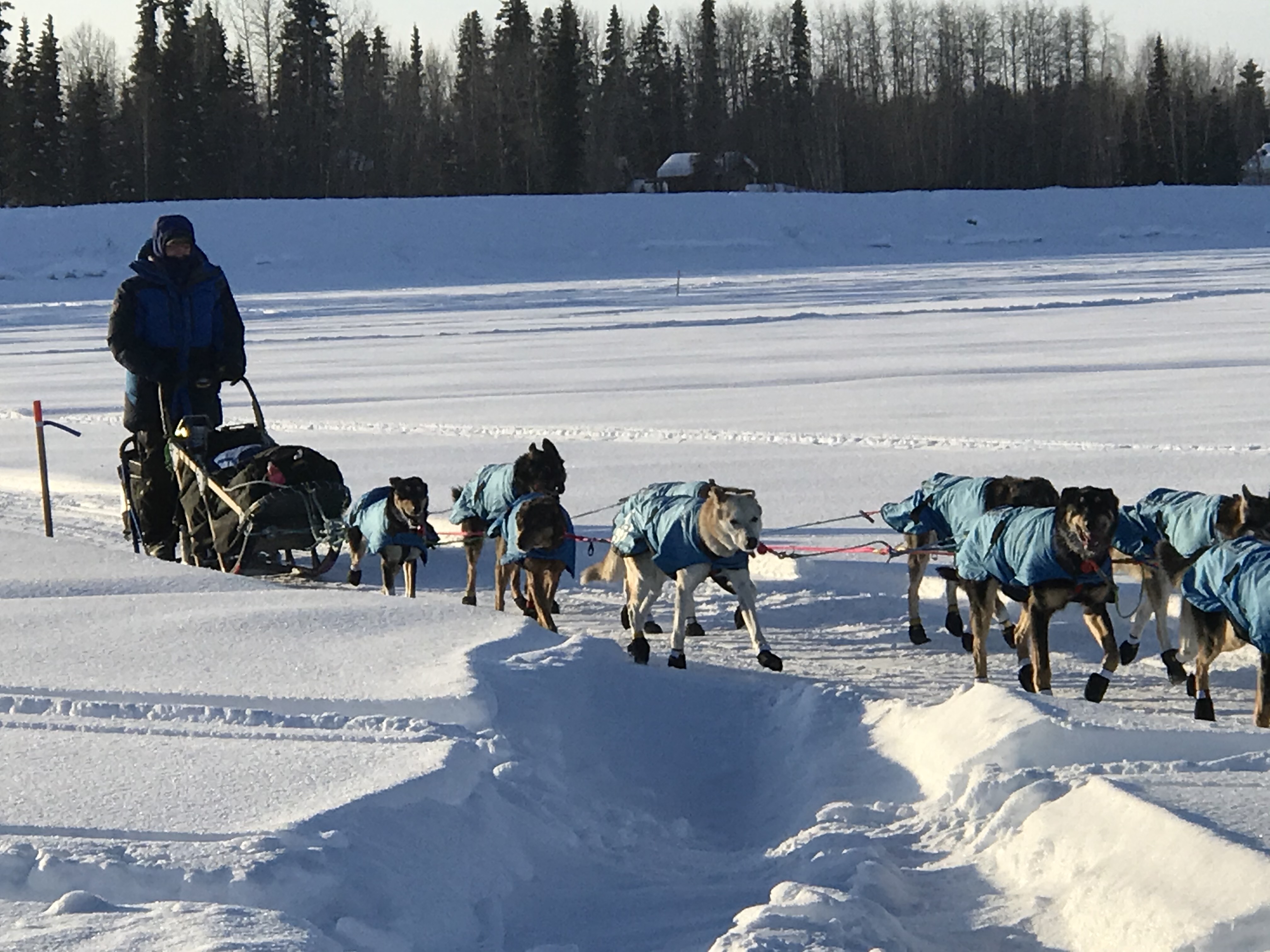
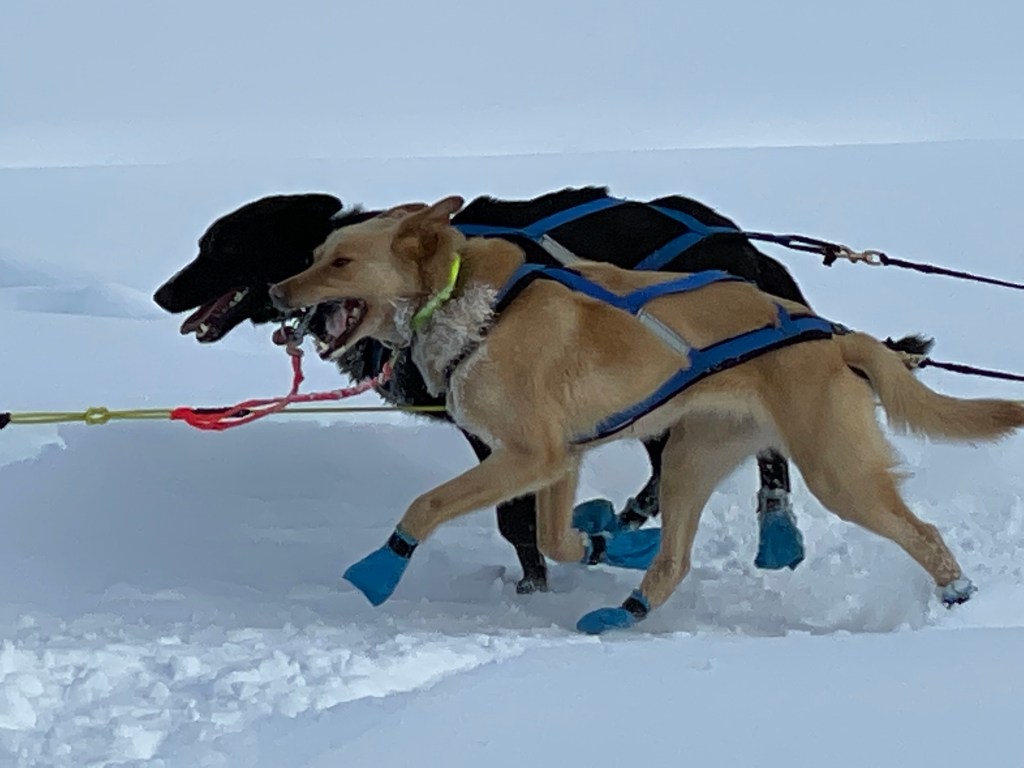
You know it’s cold when the dogs wear their parkas. These are Chad Stoddard’s dogs leaving McGrath at 5:34 PM.
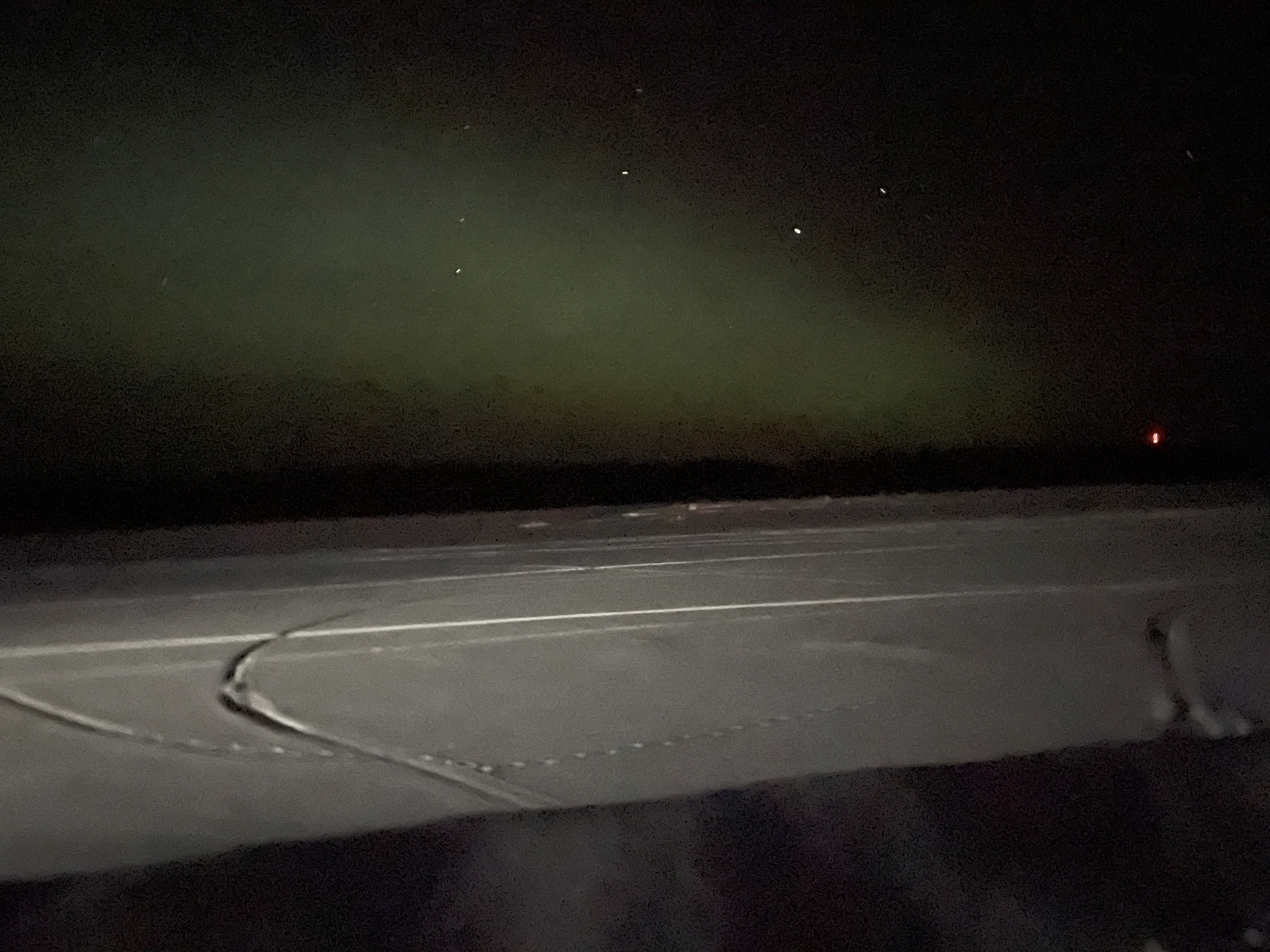
At -34 temperature in the dark, at 4:30 AM, I head to the river bank. It’s only a 50 yard walk. Our landlord had texted last night at 10:30 that the northern lights were out. I read the text at 4:00 am. Who’s up at 10:30 pm? Before leaving the house, I checked the tracker and a couple of mushers in Ophir’s -55 temperature were heading back to McGrath. Mushers don’t usually complain about cold, but they were this morning. Dallas Seavey was ahead. It was clear he’d be back in McGrath this morning.
The Aurora was disappointing. But the quiet and stars were worth the jaunt.
Every morning I wake about 2 hours before Terry. Under headlight glow, I make coffee, gather my laptop and books and teeter up the ladder. The loft is warm. I sit on a mattress on the floor and set my laptop on a bed stand. Now the sun comes early enough that it will grace me before Terry does. I love this space.
When the sun sheds its first light, I reached up to remove my headlamp and the elastic string wound up a clump of hair near my forehead. I heard Terry rising. Help! He patiently tried to unravel it, but the scissors had to be employed.
Our morning brings many futile efforts. We both will need Covid tests to leave here. The clinic’s phone has been down for two days, nevertheless, we keep trying the number. Our Full Circle veggies due Wednesday did not arrive, old story, but we repeatedly check the message board. Even though everyone I know has receive their Covid shots, I can’t get an appointment, but I continue calling around Santa Cruz county venues. Just bothersome problems.
We watch the progress of Seavey – he’s getting close. Coming from the west into McGrath, we lack a viewpoint to watch mushers arrive, but Terry wants to go down to the ice and then he can search for more booties. We underestimate how fast Seavey is traveling, bingo he’s in. We guess that he’ll take his mandatory 8 hour rest, so this frees us to do chores until 5:30 when we can watch him leave.
Dragging the sled to the incinerator with our week’s garbage, the packed snow crunches and squeaks. Returning we notice NAC has made an attack. NAC is the Northern Air Cargo jet that arrives on an unpredictable schedule. Locals call it a NAC attack. It’s impressive to see the lumbering 727 jet rising over this tiny village. Will we have veggies and mail today?
No word for three hours, then suddenly it is on the message board. We head straight away to the terminal and sled two boxes home, trying to beat the freeze. PO closes at 5:00. We make it with 2 minutes to spare. We have a box of homemade cookies from Sue Walkup. Thanks so much. Now we have to make it down to the river to see Seavey leave. And there he comes.
Homemade low sugar, high cocoa chocolate chip cookies from Sue Walkup ❤️
At 9:30 PM, we’re back on the river bank watching the headlamp of Brent Sass illuminating the churning paws of his team with a green ribbon of norther lights on the horizon. And the real race begins.
We have our little corner of the river back. Terry was excited to get down on the river. It was cold in the morning -27. Terry exclaimed many times this morning, “Man, it’s warming up so slowly.”
The last time l asked Siri what the temperature was, he replied, “You just asked me that.”
“I know, but Terry wants to hunt for booties.”
Twenty years ago, Terry skied from Unalakleet AK to Grayling on the Iditarod Trail heading the opposite direction of the mushers. It was almost a 300 mile ski trip pulling a sled. He was saying today what a leap of faith it was. Back then he had no tracker or any form of communication. The temperature was mostly in the minus double-digits. He was camping just off the river in any depression in the snow he could find. During his hours of trudgery he would talk to the passing mushers and pick up the doggie booties the dogs lost along the way. He collected a couple hundred.
Now he can ski, pick up booties and return to our cabin with a curl of smoke from the chimney. However, we must wait for the warm part of each day to go out.
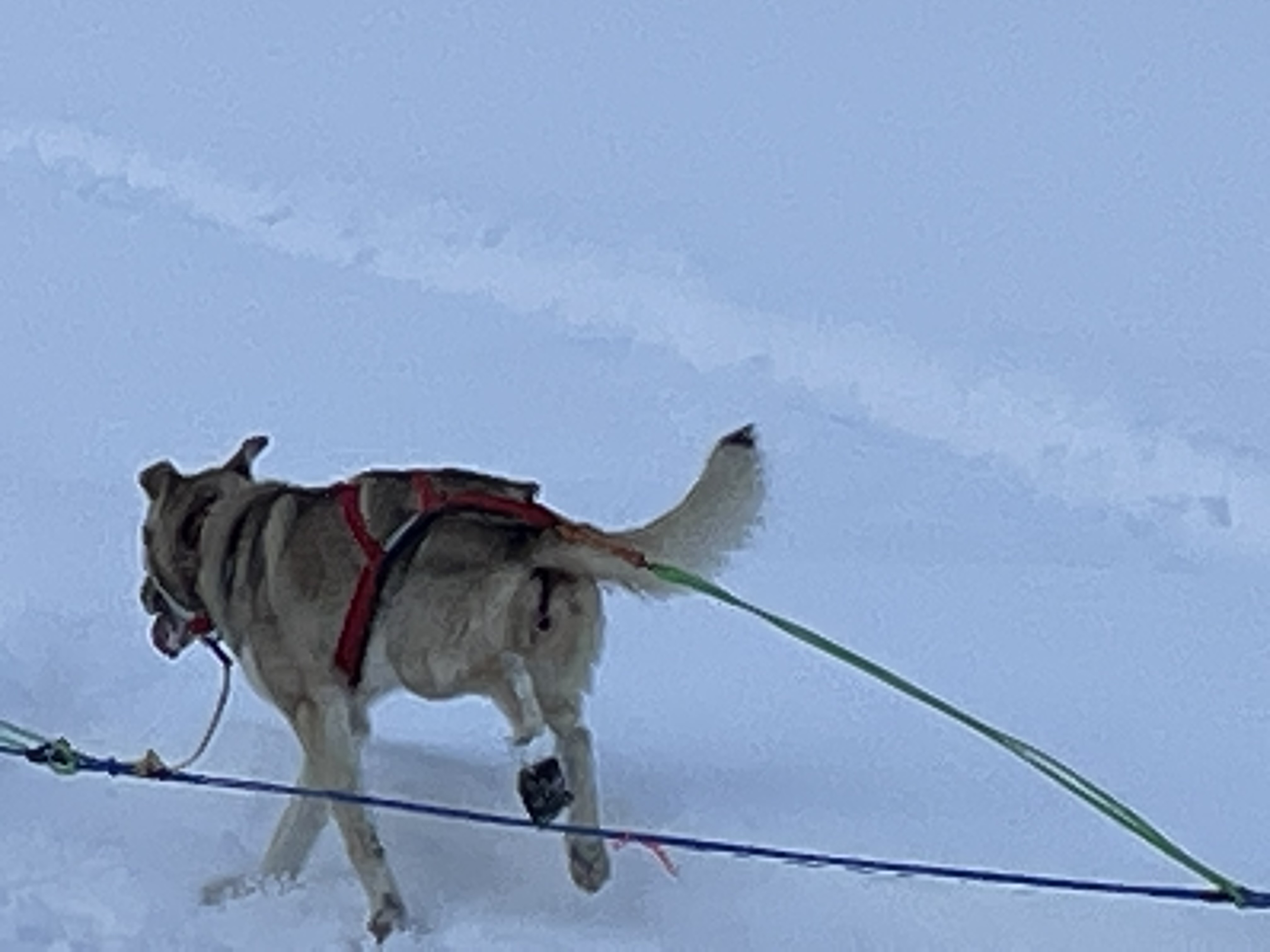
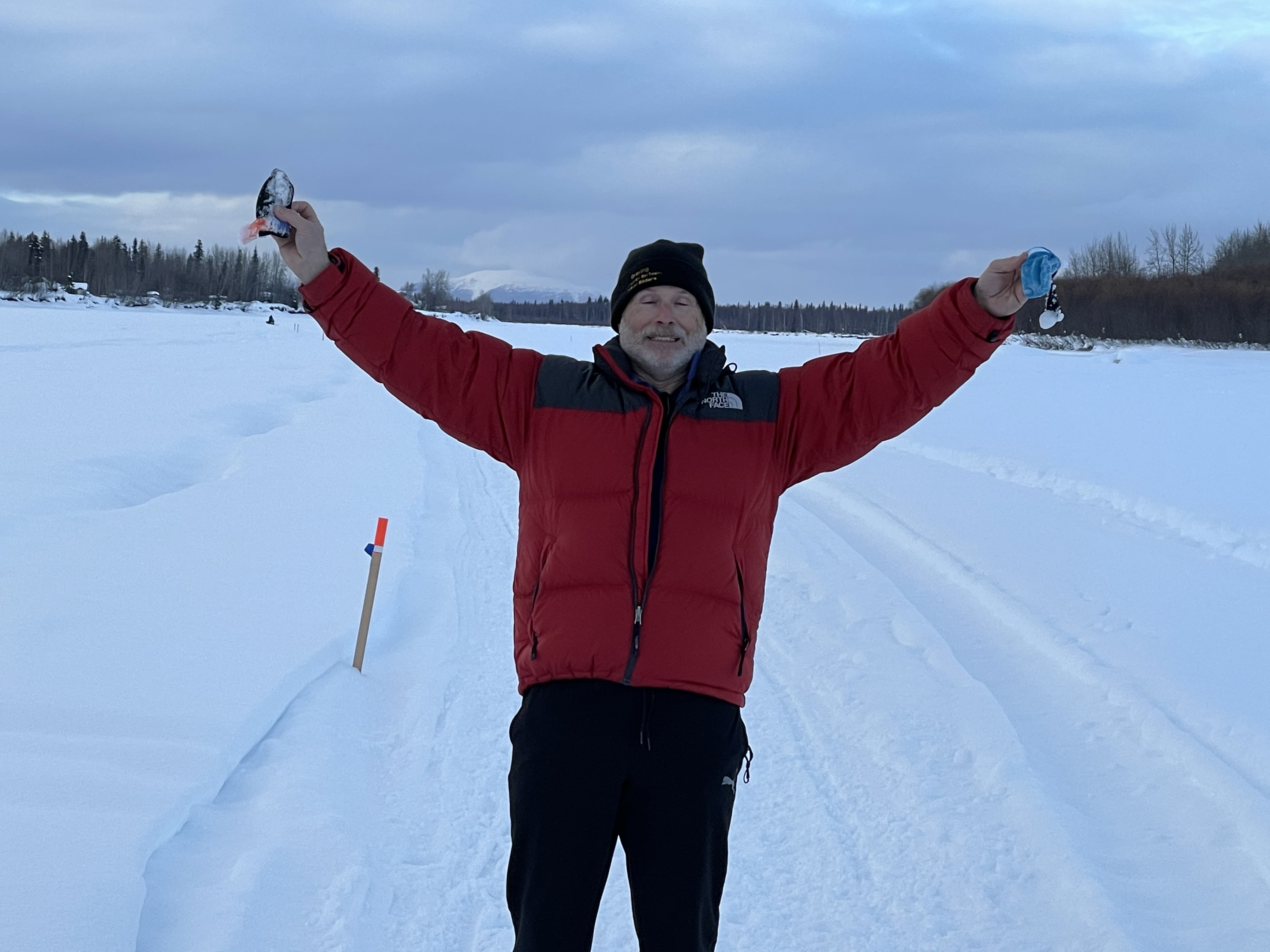
There it is, right paw’s missing bootiesTerry’s got Booties!
He looks in good position because he’s currently in 11th place and he’s taken both the mandatory rests a 24h and an 8h
Ryan Redington, age 38. I am racing Iditarod because I love the Iditarod and the dogs. My grandfather is Joe Redington Sr. He is known as the ‘Father of the Iditarod’ for starting the race in 1973. My dad is Raymie who has raced in the Iditarod 14 times. My grandpa, dad and Uncle Joe are all in the Mushing Hall of Fame. I got big footsteps to follow and am glad to be racing in the 2021 Iditarod. In the 2020 Iditarod I had my best finish in eighth place. Henry, Ghost and Splint are my lead dogs. My daughter Eve and son TJ are also carrying on the family tradition racing. They love dogs and mushing. http://www.redingtonmushing.com
The 2020 Iditarod Rookie of the Year, Mille Porsild started mushing in 1992, running a team of Polar Husky sled dogs for polar explorer Will Steger on a three-month-long dog sled expedition in Canada. She was hooked. Ever since Mille has lived with her sled dogs to experience the people and places in the magical North while finding ways to be sharing the adventures with people around the world. She has slept more than 1,000 nights in a tent on the dog sled expeditions and feels home anywhere in the circumpolar Arctic. Mille has done 15 long-haul expeditions with her freight dogs. Each expedition lasted two-six months and was as long as 3,000 miles in greenland, Russia, Sweden, Norway, Finland, Alaska and crisscrossing Canada. In 2011 she entered her first sled dog race, running the 800-mile Nadezhda Hope race in Chukotka, Russia. Mille then moved to Alaska with Team Racing Beringia and her then partner, Joar Leifseth Ulsom. Together they trained and raced with great success that culminated in 2018 with his Iditarod championship.
Mille was born and grew up in Denmark until she came to america and did her first dog sled expedition at 18 years old. Her great-grandfather founded the world’s first Arctic research station in Greenland. His sons traveled Arctic North America by dog team and canoe in the 1920’s, the “normal” son being Mille’s grandfather who left Greenland to live back in Denmark. Growing up, Mille would sit in his basement surrounded by drawings, mystical cravings and seal skin clothing, listening to his adventures as a kid across the ice with his sled dogs. That’s when Mille decided she wanted to grow up to live her life with sled dogs. Mille will be racing the 2021 Iditarod for Team Racing Beringia.
Veteran musher Brent Sass (bib # 21), of Eureka, Alaska, is the first musher to reach the Iditarod checkpoint, the halfway point of the Iditarod Trail Sled Dog Race. Sass arrived at 6:08 p.m. with 14 dogs.
GCI technician Bob James presented Sass with the Dorothy G. Page Halfway Award. By arriving first to Iditarod, Sass has a choice of either $3,000 in gold nuggets or a smartphone of the musher’s choice with a year of free GCI service.
The halfway award honors the late “Mother of the Iditarod,” Dorothy G. Page. The trophy, which is made of Alaska birch and marble and features a photo of Page, remains year-round at Iditarod headquarters.
“GCI is committed to supporting our community and traditions, now more than ever. As the official technology partner, we want to connect kids and fans of this Alaska tradition to the race and give them something to look forward to while many are distance-learning and hunkering down at home,” said Kate Slyker, GCI’s chief marketing officer.
This award will be re-presented to Sass at a later date.
Veteran Iditarod musher Gunnar Johnson (bib #11), of Duluth, Minnesota, has been withdrawn from the 2021 Iditarod race at approximately 3:15 p.m. today due to a positive COVID-19 test at the McGrath checkpoint.
Iditarod Race Marshal Mark Nordman, in consultation with epidemiologist Dr. Jodie Guest, made the decision to withdraw Johnson, who is asymptomatic, based on the protocols established in the COVID-19 mitigation plan. Under this guidance and per the Iditarod race rules, Johnson understands that he has been withdrawn. He is incredibly disappointed and felt his dog team looked great.
Per the mitigation plan, Johnson:
Was immediately notified by COVID-19 Team personnel of the positive results;
Was immediately removed from the checkpoint area by COVID-19 Team personnel to isolate away from others in an Arctic oven tent; and
Will be removed off the trail using safe transport.
Per the COVID-19 mitigation protocols, all mushers are tested for COVID-19 just outside the McGrath checkpoint using a rapid antigen test. Johnson was tested by a COVID-19 Team member and the rapid antigen test came back positive. Johnson was then re-tested twice using a molecular-based COVID-19 test and both results came back positive.
Johnson did not come into close contact with race personnel or community members, nor did he enter any buildings or community spaces in McGrath. However, he did park his team as he was planning to rest at the checkpoint.
The COVID-19 Team is in the process of contact tracing and performing additional mitigation measures as needed. The State of Alaska has been notified of the results.
Johnson had 14 dogs in harness at the time of the withdrawal.
We were scoping out the venue before the mushers and teams arrived. During this COVID time, everything is under wraps. Terry discovered a small drive on the edge of the landing strip. Toward the river a sign said “ROAD CLOSED” and on the other side of the road it mentioned something about not entering. Ahead we saw a couple of people milling about inside a fenced compound. As we edged closer, it was like someone pulled back the curtain to unveil the carefully organized area with all the essentials for dog care: straw, food, foot remedies. A man quickly came upon us and said, “This is off limits to everyone except volunteers and participants”. Our first COVID event and we ignored the rules. And Terry is in quarantine. This is no joke. I’m ashamed.
To track the races events from a distance, I purchased the Iditarod Insider program for my computer. It’s really busy with information, but it’s great for learning. The only way we know a team is arriving it from the program’s tracker. Each musher is wearing a GPS. One of the TV reporters told us Dallas Seavey would was coming in and would be there some time after 1:30. From the tracker, we knew he was coming. It was hard to estimate when. We returned about 12:30 because we wanted to buy some hot chocolate from the homeschool kid studying in his mom’s Loco Cocoa tent. We could have walked away with two Cocoas and five dollars, if Terry wasn’t honest. Math skills weren’t important to our cashier. Seavey arrived at 4:00. Luckily it was twenty degrees, but we shouldn’t have drunk the Cocoa. Looking for a musher, involves staring into the white, afraid to take you eyes off the prize and letting someone else spot the movement from down river before you. About 15 local spectators lined the narrow snow path overlooking the bank. The trail is almost mid-river at this point, so the view somewhat distant. In Grayling the teams ran right in front of our house and lined out their teams all around us.
After Seavey, we made a quick run home, approximately a mile. I checked the tracker and discovered that three more mushers were due shortly. We were going to do our own estimation of ETA. Every 5 minutes it tells how many miles they are from the checkpoint. We walked down to the river to get closer to the trail. Using the information on how fast teams were moving, we could be within five minutes, if they don’t stop to pee, snack their dogs, etc. Our new vantage point was only 20 feet off the course. We watched the next three until it was almost dark at 7:20. One of them, stopped about 200 yards away. I was filming his approach and my hands were getting cold. Deb had her binoculars, and we finally noticed he was making yellow snow.
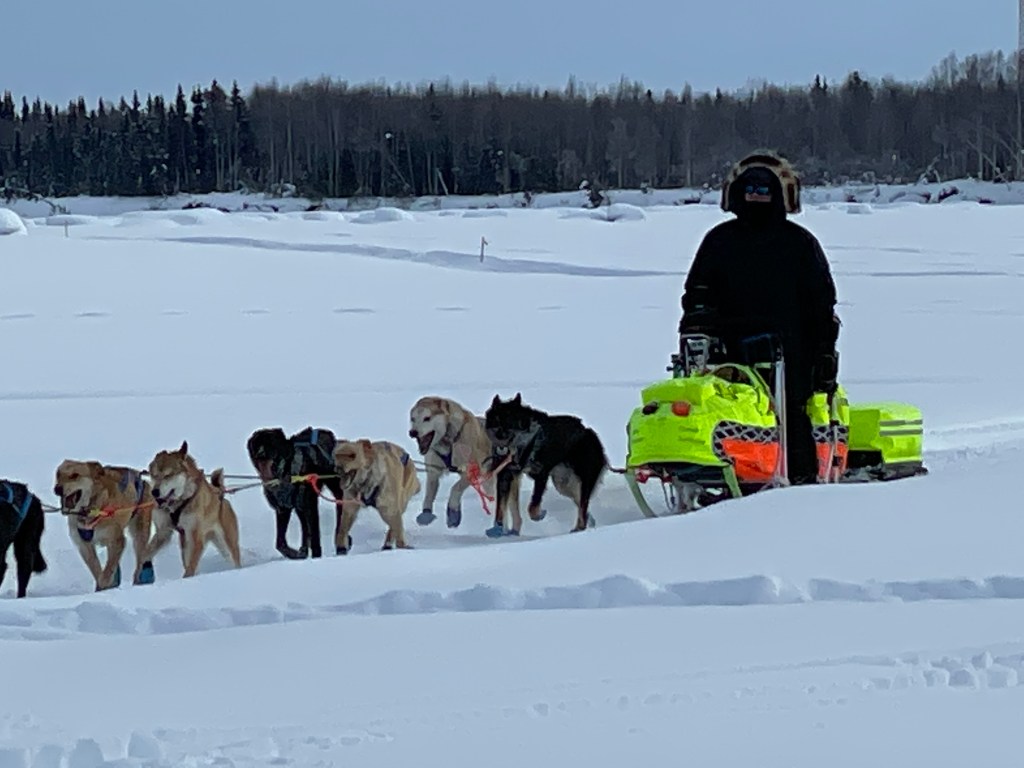
At 5:00 AM I watched two more teams, under the headlamp. It’s a gorgeous flow catching glimpses of bootied feet, and long tongues, and crisscrossed halters under a towering light. And that fast crunching tempo on hard packed snow.
I woke Terry and he made it out for two more teams with the waxing civil twilight showing more forms and less ghosts.
During daylight we watched all of the teams, save one that has not yet arrived, the last one, the red lantern team. We were in and out all day, sometimes walking and talking with Elsie. Terry also joined Eva, the ice fishing fanatic, for some good fish tales, but no caught fish.
Yesterday was troublesome for mushers. It was too warm, nearly 30 degrees above. They would rather run in -30 conditions, as the dogs overheat. Also, the wet snow pushed down on the river ice, squeezing water out the edges, which flows under the snow pack toward the center. This is overflow. It is invisible, until a weight pushes down the top snow. That weight is usually a dogs foot, sled runner, or snow machine. Nobody likes cold, wet feet, even dogs. Snow machines can bog down and have to be abandoned. Today was around 10-15 degrees, with some overflow still lurking. Tomorrow will be around -20 and the pace will pick up.
According to GPS tracking, a group of Iditarod teams has left Nikolai. They should start arriving between 8:00 and 9:00 Alaska time. We’ll be out watching the river.
The following is from my Grayling Journal, March 9, 2001 when the first Iditarod musher arrived:
By nine we had been hanging around the river banking waiting for an hour under cloudy skies. But it was worth it. We could see the musher’s headlight shinning off in the distance and then the outline of movement, then we could make out the team and see the musher swaying from side to side, and when they got close the silence was incredible. Anything else you see coming at you with a light, makes noise. Here we’re used to the annoying sound of snow machines. But this is silence. And then you hear the musher call out “haw” for left and next “gee” for right and the dogs snake up the hill in fluidity.
We followed them up and watched Jeff King work on his dogs. Each musher has two or three human-sized bags of food and equipment shipped into every checkpoint. They open a bale of straw and fluff it under the dogs and then they start boiling water to mix food for the dogs. The musher can’t accept any outside help. They do all the work. One of the vets starts checking the dogs. They listen to their hearts and lungs and check shoulders, and feet, and hides for harness burns. Friday night was a zoo because the Iditarod checker and volunteers hadn’t fallen into a routine. They put the first musher’s dog alongside the community hall and even thought the hall was housing all these people, the villagers couldn’t forgo a Friday night without bingo, so all the Iditarod people were displaced. The locals had their snowmachines parked in the musher’s paths and they left their kids outside the hall.
The beauty of the dogs and mushers as one, really moved me. I’m looking forward to seeing this soon.
Back then, we had been in the village seven months. Here we are barely acclimated. Terry is still in quarantine. Therefore, so am I. We focus on the things we can do. Mainly cooking and outside exploring. We were working on skiing distance. But I don’t think I’ll be skiing due to my broken boot. Yesterday, Terry was in his skis, and I ran in my winter running shoes. We were the same pace. So I’ll pack my snowshoes for the deeper snow on our next outing. Yesterday, we made it twelve miles on the road. The last mile wasn’t plowed, just a snow machine trail. It was hard for me.
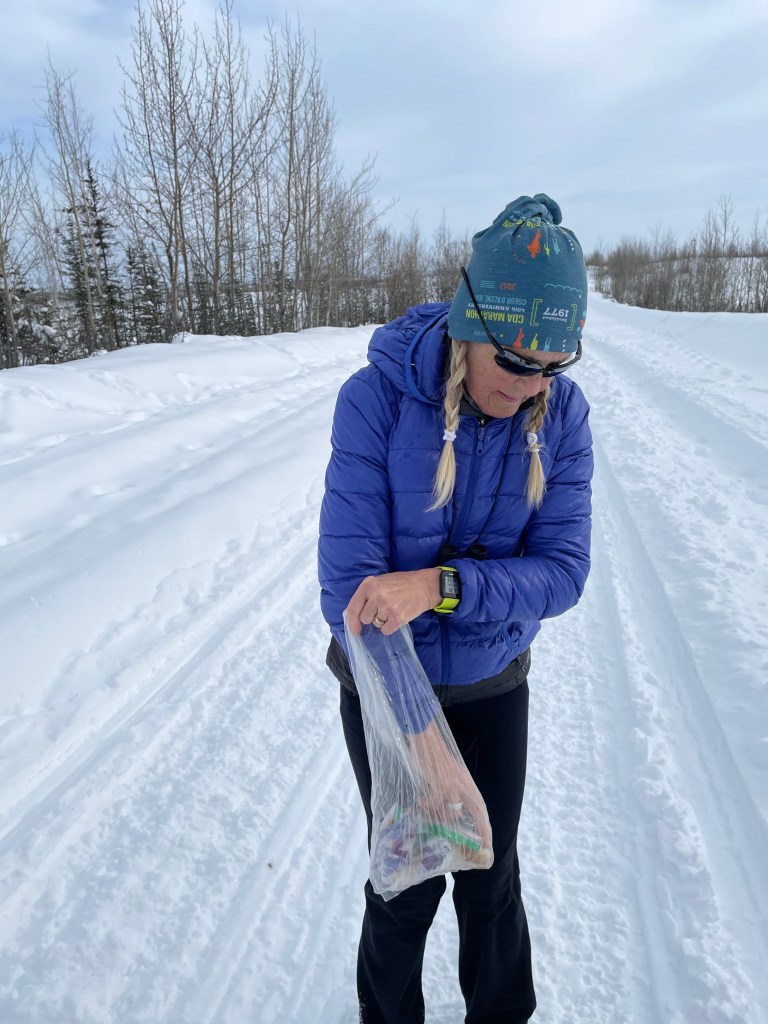
It was warm enough for our picnic lunch.
We’ve been comparing our outings to the one’s we experienced twenty years ago. Grayling is a couple hundred miles from here, in the same school district. But! There’s a 15 mile road here. It’s plowed to mile five. Trucks, SUVs use the first five miles. Snow machines use all of the road. At least one truck passes every hour or so and snowmachines are more frequent. There’s a clinic here and a State Trooper. It doesn’t seem dangerous by comparison, and not as adventurous.
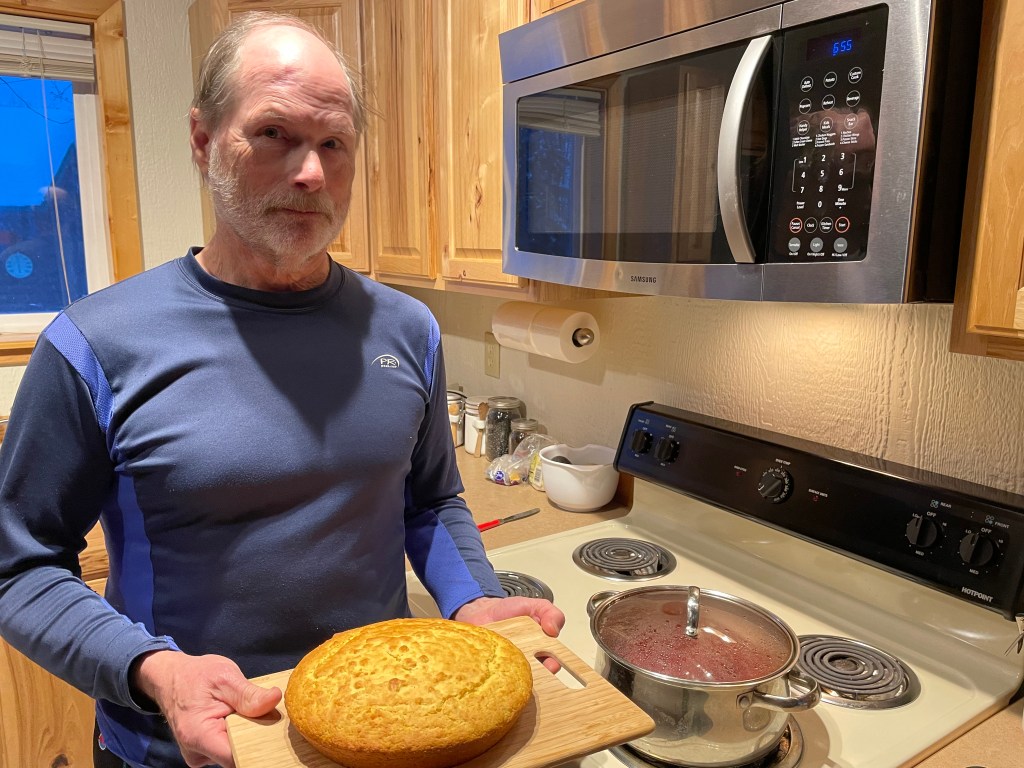
Chili and cornbread.
I guess domestic duties have their own adventure. Terry treated me to dinner late night. He’s been ever increasing his repertoire of recipes since getting involved in The Great British Bakeoff. This was last night’s treat.




 Mountain Peace