
This is from our journal written 20 years ago when I taught in Graying AK.
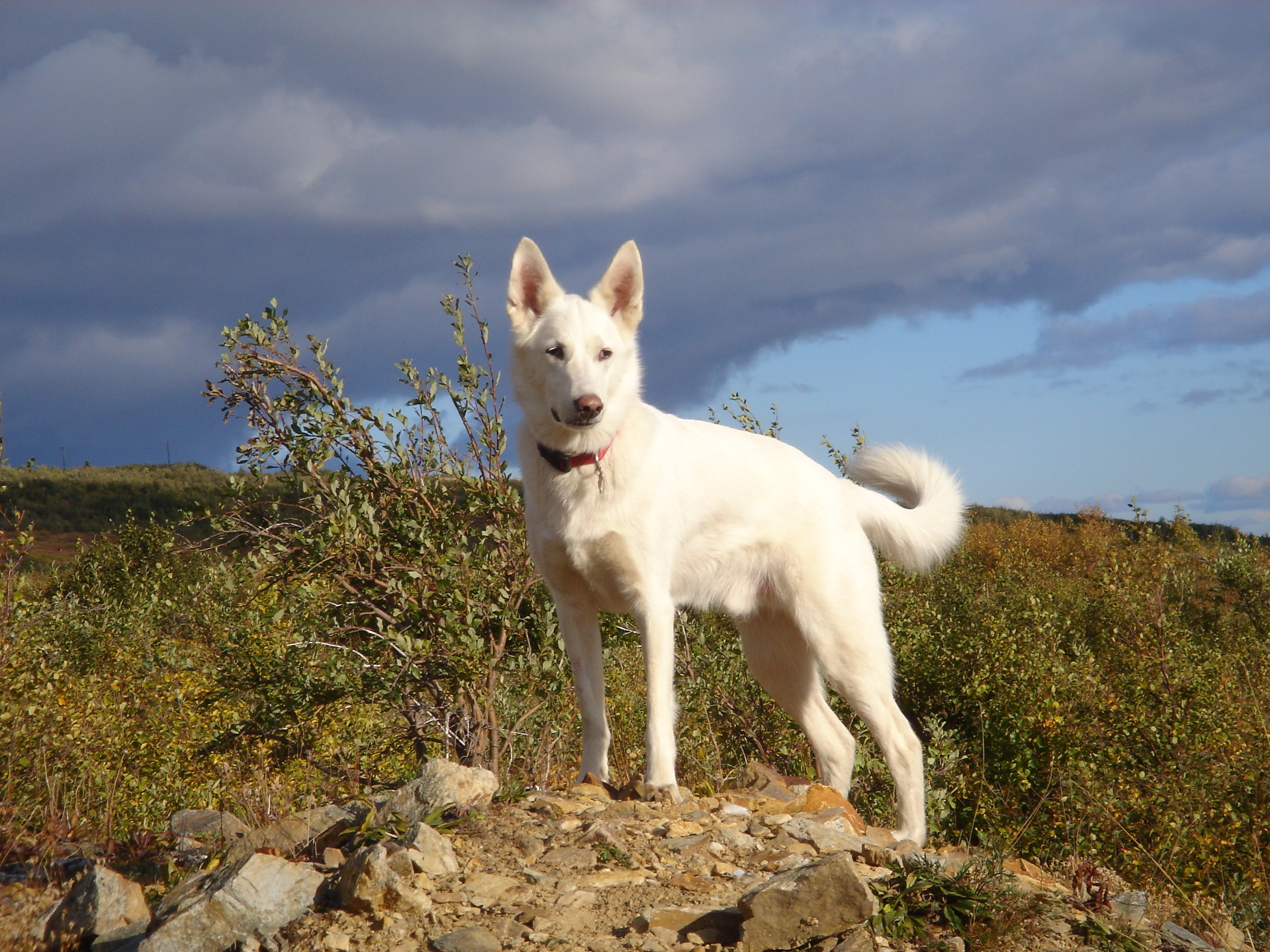
Muk’s Big Adventure #4
Friday, eight AM, we stand in the storage room behind the Anvik gym buttoning, zipping and Velcroing our clothes. I took care not to leave any of my skin exposed. My mask was tucked under my goggles, gloves cinched inside jacket sleeves, mukluks laced high. Our narrow plastic sled carried a Rubber Maid tub and two plastic delivery bags full of gear. Terry attached the dog’s stretchy blue leash to his gun belt and snapped it to the sled, with its 85-pound load. I wore a light backpack stuffed with the day’s essentials. Also on the sled were a pair of skis—for emergency use—and both pair of snowshoes. The trail was hard packed. There was no need for snowshoes this morning.
We had over-nighted on the gym floor, on a pile of wrestling mats. This is our favorite bed and breakfast. We love raiding the four freezers and having all of the cafeteria to ourselves. Muk loves licking syrup and ketchup from the floor. The gym mats, balls, baskets are ours to play with. We can lounge in the library reading and checking email. Muk had played for hours with one of the daughters of a teacher. She told him she has gold, and Muk is the gold-robber trying to get it. He didn’t mind being bossed around; it was a fun game for him, too.
The staff would start arriving by 8:00 this morning, so we needed to hit the trail. The school thermometer registered –22 degrees as we started a brisk pace down the hill to Anvik Creek. Out on the ice the coldest air had pooled, and it was colder. We didn’t talk about it. Our masks were layered in ice around nose, mouth and eyes. Muk dropped to the ground often to bite at the pads of his feet.
Anvik Creek makes a wide curve around an island that kept us in the shadows. We were both digging hard with our poles, trekking, trekking, as fast as we could. Normally, the puppy in Muk would have encouraged him to chase the occasional blowing leaf, or dig for partially exposed, left-behind Iditarod booties, but he, too, was moving fast, pacing up ahead then back. For an hour and a half we pushed hard. Just a short stop and eyelashes need to be pealed apart. In order to do this, gloves had to come off. My goggles were frosted inside and out. Through this lace of frost, Iditarod markers were barely visible. Freezing is painful; movement mitigates the pain. Even though every step kept us warm, it also pushed our distance past the point of likely retreat to Anvik. I don’t think you worry about freezing to death until you are really desperate, but I worried about frostbite.
At the confluence of creek and river, we curved directly into the sunshine. The absolutely clear air and total whiteness result in unimaginable brightness. It was warmer, maybe only a couple of degrees, but each step into the sunshine seemed better. My breath warmed the frost from my goggles. Thankfully, there was no wind. I looked back at Terry. He was totally covered in fine-frost fur from perspiration wicking to the surface and freezing. Long icicles traced his beard and mustache. His long white eyelashes look Vegas showgirl-like. “It seems warm now,” he yells. “I’ve had to chip the ice off my eyelashes a couple of times.”
By now, there was no way I could wait any longer; I had to urinate. Women have to expose so much of their body to do this. And so many simple things sap warmth. Just holding the metal part of ski poles instead of the handles—with gloved hands no less—can steal enough heat to force you to put the poles under your arms and pull your fingers into a ball. This little inconvenience will slow your pace and next you’ll feel the heat leaving your thighs. Not only does pulling down your pants and hanging your steamy derrière out into the minus-minus air assault the immediate area, but also it pulls heat from your core. This fact is a constant reminder that you cannot easily escape the cold by going into a car, a building, a store, a house, a garage. No, this is spending hours with minimal chance of rescue, and it’s on our minds, at some level, the whole way. I picked up the pace to compensate for my brief exposure. We were making good time, and my body temperature hadn’t suffered. By late-morning, we could both relax. The sun definitely warmed us and only the shadow side of Terry was still frosty. When Muk lay down, we cupped his feet to warm them. Earlier, neither of us could have stopped. Muk got up prancing. He, too, was happy with the way the day was turning out.
Up ahead I could make out an animal running. Binoculars helped identify a single, large wolf heading into an island of willow thickets. Our trail followed a channel between island and shore. Willows rimmed this island, and it was where we had seen moose two days earlier. They survive the winter primarily by munching willow stems and buds. If you break open their pellets, sawdust spills out. On the opposite side, a pair of wolves hunted the shoreline. One stopped when it sighted us and charged our direction. When it became clear to him that we were not prey, but predator, they quickly disappeared into the woods. The trail was covered with wolf tracks. We decided we were dancing with wolves. The temperature finally seemed above zero, but removing your mask quickly dispelled that notion. Still, it was a perfect day. We were both hoping to see more moose. In the distance was another movement, approaching rapidly At that pace we knew it was a snowmachine. An animal was draped over the rear. Richard turned off the engine and said he thought we were broken down snowmachiners. The wolf, shot ten minutes earlier, was the first one that we flushed out. He had run it down as it tried to cross the wide expanse of Yukon ice. It was hog-tied on his luggage carrier. Blood spray covered the rear of his machine. The animal’s tongue hung frozen stiff, eyes still open. Muk didn’t growl or act surprised. He looked it over and decided the break was an opportunity to lay down and rest. The feet on a wolf are huge. I doubt few dogs have such big feet. There’s a one hundred-dollar, native only, bounty on wolves, plus the untanned hide is worth another $250. Wolves have really depleted the moose population, along with illegal hunting. I had just been considering how sad it is that moose are so large and it’s so hard for them to hide. Just when they bed down, the wolves come in and rip them apart.
In the novel Winterdance, by Gary Paulsen, he talks about how brutal it is to witness wolves killing deer. I don’t want to see it, nor do I want to see an Native Alaskan running down a wolf on his snow machine. But out here it doesn’t bother me seeing the dead wolves, the way at home it bothers me seeing cows or chickens being transported to the slaughterhouse. Something, to me, about the scheme, seems more sporting, more natural.
Much of the river appears as frozen swells undulating toward shore. A feeling of walking on water progresses to the feeling of being on a boat dipping up and down on the waves. At times, we were between troughs. Sometimes the ice peaked up into winter sculptures. Way below-zero snow cracks hollowly under your feet—it’s not the crunch of cold-weather snow or the pad of warming snow. The Athabaskans have sixteen words for the different types of snow. We surely have seen it transform today. The distance is marked by high cliffs rising from the Yukon’s western shore. To the east is flatland. While in Anvik last summer, one of the Natives had told me the names of the peaks—four mile, eight mile, twelve mile. Near the high cliffs, the shore ice is devoid of snow. It’s glacier blue. The cliff’s snow is glazed and shiny. Somewhere around here is the open hole, which has claimed the lives of many people over the years. It is hidden by deep packed snow now, but still dangerous. We trust the trail gives this area sufficient detour.
As we walk, these cliff markers approach slowly. It reminds me of sailing and wondering what it will look like around the bend. As we get nearer to Grayling than Anvik, white capped hills rise dramatically in the distance. The north wind begins and increases as we head upriver. I slow because of a tightening Achilles. Walking in Mukluks takes its toll after fifteen miles. With no heal or real shoe box to grip my foot, it’s almost like being barefoot. The slight movement of my ankle against wool socks has caused a rash that now flares. For a couple of miles, Muk has been bored and tired. Because I’m in the front, he has been trying to get me to stop. He walks between my poles and me. He looks up pleading. He leans against my leg. He walks up between my legs. He tries to trip me. I know how he feels.
About a mile from home, Terry says he’s going to push ahead to start a fire for us. We had set the diesel burning stove on 55 degrees. I’d like a warmer house. He powers ahead, and as the distance increases, Muk stops and looks at me then runs ahead and continues this until they disappear down the hill that leads to the village. I hear the village dogs going wild. When I get up to the village, I see a sad sight. Aimee and Mike acquired two puppies last fall. One was Muk’s brother, Reno. They gave him away a couple of months after they got him. Two dogs were too many for them. But McGregor, the goofy looking one, remained. He had become a long-legged, silky-coated animal with the ears of a donkey. He looks like no other in the village. They let him sleep on the couch and walked him around the village. But two weeks ago, anticipating their trip home this summer, they talked Fred into taking him. As I came up the hill to the village, the dogs in Fred’s yard, behaved as all the village dogs do. They jump to the maximum extent of their chains. They bark and yelp. They all look like village dogs—huskyish. Remember, they are staked so that they can never touch each other. Their only contact is when they are fed. Perhaps a good owner pats them, but mostly they are knocked on the head or kicked so that the feeding process is quick and unencumbered by dogs so starved for attention that they literally grab your leg with both arms and hold tight. There sat McGregor. He looked to the other dogs and occasionally barked or jumped, mimicking their behavior. His ears stood at attention while his eyes and movements betrayed his bewilderment. Where is the couch, the dog dish always filled, the warm confines?
I reached home about 3:30, shortly after Terry. He said, “You better go to school and take a shower.” Why would I go to school for a shower? It was warm inside compared to outside, but then I notice that I could see my breath. The stove had failed. It was 26 degrees. Water pipes were frozen, all the plants dead, even the olive oil had solidified. The only items to escape freezing were in the refrigerator. Muk immediately curled tight inside his kennel where he stayed without moving until morning. We lit a fire and walked to school. The hot shower I needed turned into a cool one. Nothing is ever fixed. Why there is no hot water in the shower is a mystery, but I’m sure it will not be fixed. Little things in my classroom that Terry had started to fix, but was told not to because he was taking away Fred’s job, have never been fixed. Only the bare essentials of everything work. By evening, the house warmed and pipes thawed. Unfortunately some were damaged. Water squirted from under the sink and shower extension pipe. It also dribbled from the toilet bowl gasket. Using duct tape, a clamp from his bicycle, and numerous tie wraps, Terry has temporarily repaired the breaks under the sink and in the shower. The toilet leak stopped when the gasket fully thawed. I know that Fred will never fix these problems. The next tenants will have constant drips. We’re sorry, but the store doesn’t stock the parts to fix these problems. Bush living.
That mostly describes the final day of our trek. Our original plan was to visit Anvik, then Shageluk, then triangle homeward, spending four days to cover the 83 miles. This overly ambitious plan was cut short by a very painful first day. I had not spent much time training and by mile 15, the snowshoe bindings had nearly crippled me, constantly squeezing my Achilles. Mukluks have no heel stiffener for protection. A limpy pace is a slow one, and I could no longer maintain body heat. Hand warmers were not enough to keep my hands from going icy. Terry and I swapped gloves several times so that I could benefit from his warm hands. With five miles to go, I was struggling with a falling core temperature. Feeling your spine growing cold is eerie. Terry was constantly urging me forward, “help yourself, pick up your pace, shake your hands, we’re almost there”. Unfortunately I was going as fast as possible, but the landmarks never came closer.
In my pack was a VHF radio and considered calling for help, but who would answer? And what would my class and peers think of me? Finally, Terry, sensing that I was really fading, came close, putting his arm around me, holding me tight, pushing me forward. The closeness added heat and security. As we walked in lockstep, my core stabilized, albeit below normal. Adding more handwarmers to my gloves failed to produce noticeable effects, but the buildings of Anvik were coming into view. It is almost a mile up the hill to Denise’s house. Due to my condition, Terry flagged down a snowmachiner who carried me to her door. She was expecting us, but was surprised at my icy touch. For several hours I snuggled on the couch wrapped in heavy blankets as heat from her blazing woodstove toasted me back to normalcy.
Denise is a cute, petite, 40-something woman. Carl, our special education teacher, has told me repeatedly how foxy he thinks she is. When we were in McGrath last week, he was prodding me to see if he stood a chance with her. She’s from MT. Her husband is at home. The plan was that she’d work here for two years until he took his sabbatical—he’s a teacher too. Then he’d join her with the idea of maybe moving. Her 22-year-old son is with her and may remain in Anvik. She has decided to leave at the end of her first year for many of the same reasons that I have outlined in earlier letters. I assured Carl that she was indeed married and not looking for anything else.
For a short time, Carl was a glassblower in Seattle. His personal mythology is that he’s a cultivated, eccentric artist, with joie de vivre—at times debonair, at other times Paul Bunyon-like. In truth he’s a likable fool. Sloppy, fat, whiny. He’s stuck in jr. high mode. When he feels insulted, he’ll say, “You guys wait. Just wait. I’ll lose weight and show you all.”
Near the end of our two-day inservice, Carl decided he had to make a move. He inched down the lunchroom table toward her. I was seated across from them and watched this tragicomic play of Carl’s. He put on his oh, so sensitive voice. He asked her about her troubles in Anvik. He told her how brave she was and how well she was handling things, and by the way, had he mentioned he was a glassblower in Seattle? Even though he loves the bush, he knows the finer things in life—coffee mostly.
When he returned to Grayling, he couldn’t stop himself from emailing her. He confessed his attraction. Carl always does stuff like this. At the McGrath meeting, in front of the entire school district staff, he would raise his hand and whine about this and that. The speaker would politely cut him off. Then for the rest of the meeting, Carl told everyone that he should have kept his mouth shut and that he’s always embarrassing himself and putting his foot in his mouth. Of course, everyone said, “It’s OK. You shouldn’t feel embarrassed. You were just speaking your mind like we all want to do.” In truth, everyone thinks he’s a goof ball.
Denise emailed a response that she’s happily married and she’s sorry that he couldn’t understand that. Both Terry and I picture Carl banging his head against the wall and repeating “Why me? Why me? Why do I always embarrass myself?” That’s Carl.
 Mountain Peace